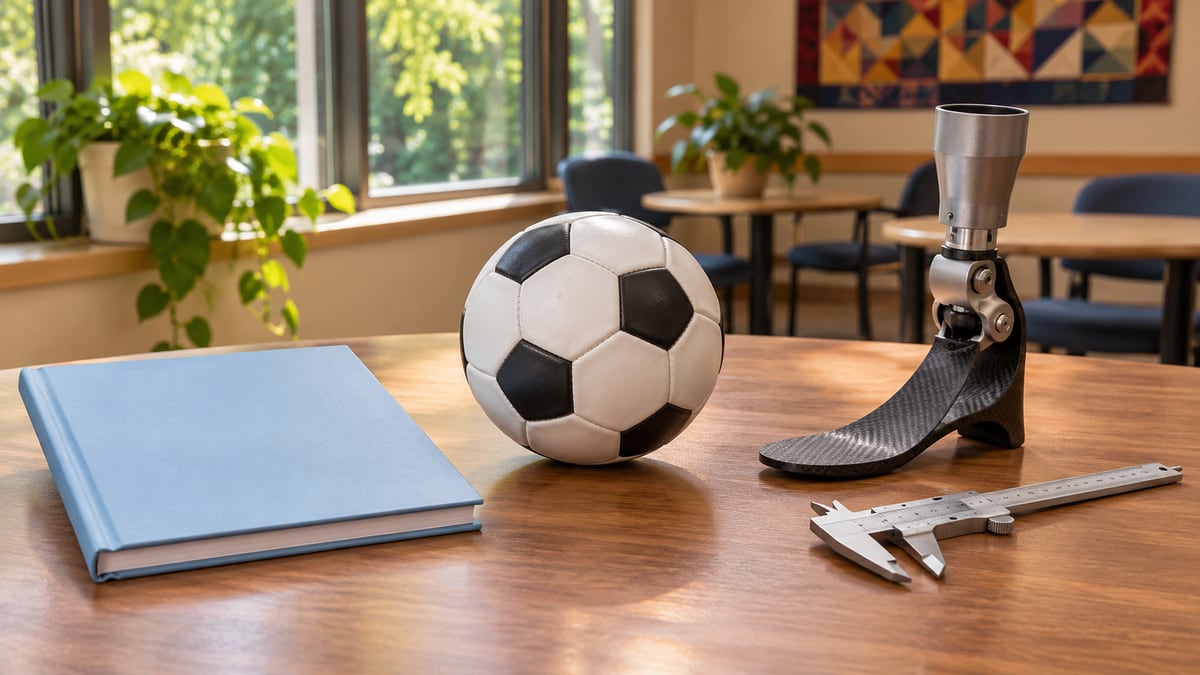
A children’s book, amputee soccer and a prosthetics study earn AOPA recognition
AOPA’s three 2027 Rising Stars work on questions that follow people out of the clinic, from understanding a first brace to measuring the value of a sports prosthesis.
Follow a beat
This is the people beat: support networks, local initiatives and the ways communities make room for each other. We report the specifics without turning someone’s life into a lesson.
Need a practical starting point? Browse Guides for families and supporters ↗Latest story

AOPA’s three 2027 Rising Stars work on questions that follow people out of the clinic, from understanding a first brace to measuring the value of a sports prosthesis.
The archive
The Clearwater nonprofit covers professional fitting costs when insurance falls short, replaces devices as children grow, and bills recipients nothing. SAFE Structure Designs, a Las Vegas defense engineering firm, announced this week it is joining as a donor.
John Brinkmann built the American Academy of Orthotists and Prosthetists Behavioral Science Society from scratch in 2017. His successor, Jacalyn Harris, takes over a society that has spent nearly a decade making the clinical encounter's human side a formal professional concern.
Make for Good pairs 24 accessibility design briefs with a global 3D-printing community. Here’s what the contest includes, how to explore the designs, and why user testing matters.
NUPOC launched a 70th anniversary site ahead of a February 2028 event. The center has trained prosthetists and orthotists since 1958, when academic programs for the profession were rare. Moxie Calder on what an institutional birthday actually measures.
A wound from a borrowed camper is what's standing between a Mississippi man and his first prosthetic. The neighbors trying to help him understand the order of operations even if they wouldn't describe it that way.
LIMB-art, a small North Wales company founded by former Paralympian Dr Mark Williams, reduced cover production from two days to two hours with laser-cutting equipment. It is the only company in the world doing what it does.
At the 2026 AOPA National Assembly in Las Vegas, the global prosthetics manufacturer launched Unleashed, a 20-story collection from people with limb loss and limb difference. The company says what it hears will shape its plans for next year.
A Q&A in The O&P EDGE asks Patience Nicholls, Kirstin Drexler, and a technician at Shriners Children's Greenville how they entered O&P fabrication, what the credential landscape looks like, and where the field still creates friction.
The Live in Motion Foundation added Lesleigh Sisson, Shree Thaker, and Brent Wright to its board of directors. Two of the three carry formal O&P credentials, which says something about how the foundation connects to the clinical field.
The USA Patriots veteran amputee softball team returns to Huntsville for their annual Rocket City game. On what events like this do for the community, and the gap between a stadium moment and a structural answer.
A 2008 paper projected that limb loss in the U.S. would more than double by 2050, driven by diabetes and vascular disease in an aging, racially disparate population. Eighteen years on, the clinical and commercial ecosystem is still catching up to who it actually serves.
For people who lose a limb to vascular disease or diabetes, the risk of a subsequent amputation is documented, significant, and consistently underemphasized in clinical practice. Here is what the research shows, who carries the highest risk, and what the gap in follow-up actually costs.
Physician Devina Wadhwa writes that the 'difficult' label tells us how a clinical encounter felt, not much about the patient. In prosthetics care, where socket fit complaints and insurance advocacy can look like friction from one side and medical necessity from the other, that distinction has downstream consequences worth knowing about.
The American Orthotic and Prosthetic Association is accepting nominations for early-career O&P practitioners to be named 2027 Rising Stars. What the program is, what professional recognition does in a specialty this size, and who gets to decide.
The Amputee Coalition's Peer Visitor Network trains certified volunteers with personal limb loss experience to connect with people newly facing amputation. What the program is, how it works, who it reaches, and the honest gaps.
Studies spanning decades have found that a meaningful share of upper-limb amputees stop using their prostheses, and that the reasons are practical, not a failure of attitude. What the data shows, who it describes, and why the community conversation barely acknowledges it.
A corporate milestone announcement from Stratasys marks over a decade of 3D-printed prosthetic devices delivered to children through a charitable partnership. The number 'hundreds' is real work. It is also a useful window into who these programs reach and what they can't fix about the pediatric prosthetics system.
The O&P EDGE reports the death of T. Walley Williams III, MA, PhD. His career began in the postwar era that produced the first generation of prosthetics researchers. Here is what that founding moment looked like, and why fields don't always keep good records of who built their floors.
Humanitarian organizations have documented a massive rehabilitation deficit for Gaza's amputees and a persistent shortage of the prosthetic materials required to address it. What the bottleneck is, why it persists, and what the organizations working there are asking for.
Bionic Skins hired Bri Perry, CPO, as prosthetist and clinical manager after about a year at ForMotion Clinic. In a field where 78 percent of practitioners report burnout and the supply of experienced clinicians is structurally limited, individual moves accumulate into access patterns.
The O&P EDGE polled its clinical readership on 3D printing barriers and influencers in professional education. The 39 percent who named cost as the top challenge are describing something different than the affordability headlines. The influencer question describes something else entirely.
A Mount Prospect community rallied to raise more than $200,000 for a teen following an amputation. That's genuinely good. It also tells you exactly what insurance didn't cover, and who never gets a fundraiser that goes viral.