
Nine years of asking O&P clinicians to think about the relationship, not just the fitting
John Brinkmann built the American Academy of Orthotists and Prosthetists Behavioral Science Society from scratch in 2017. His successor, Jacalyn Harris, takes over a society that has spent nearly a decade making the clinical encounter's human side a formal professional concern.
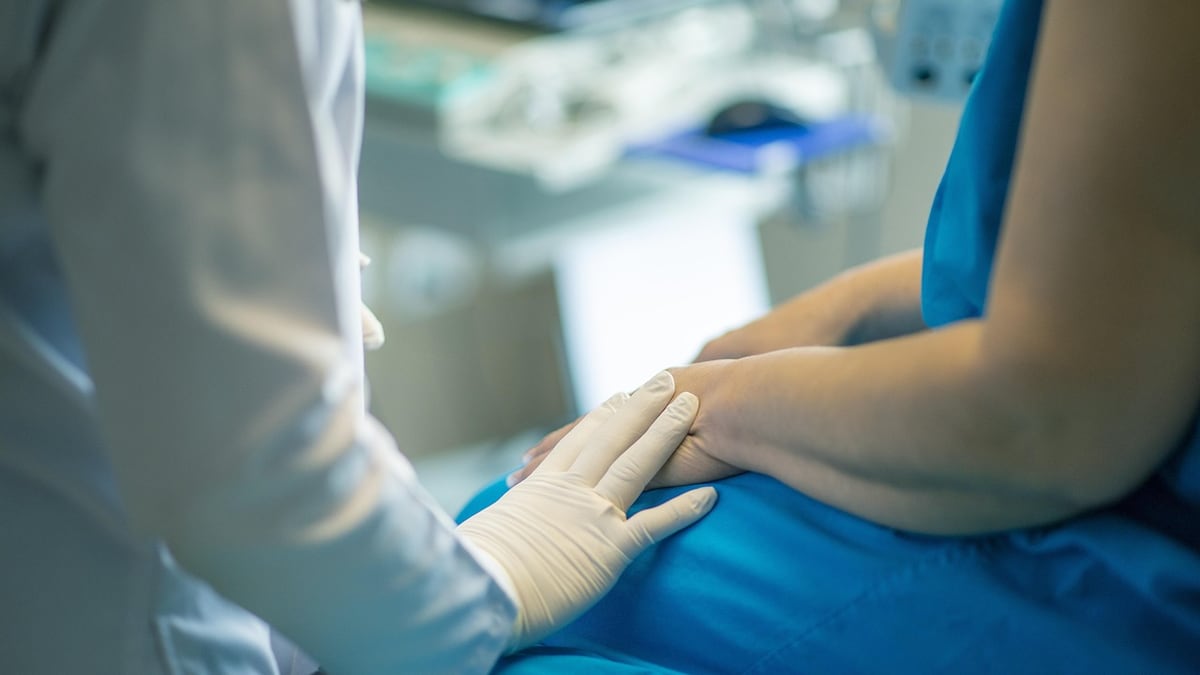
There’s a lot of attention paid to what a prosthetic fitting produces technically. Whether the socket fits. Whether the knee joint responds. Whether the gait pattern clears a clinical threshold. What gets less attention is what happens in the room: whether the patient can say what they’re actually afraid of, whether the clinician can hear it, whether the relationship between the two shapes what the device does in a real life rather than a gait lab.
That gap is what John T. Brinkmann spent nine years trying to close.
Brinkmann is stepping down as founding chair of the American Academy of Orthotists and Prosthetists Behavioral Science Society after nearly a decade in the role. Jacalyn Harris, MPO, CPO/L, took over as chair on October 1. Samantha Stauffer serves as vice-chair; Nate Kearns is education officer.
What the society set out to do
The society launched in 2017. Brinkmann, an associate professor at Northwestern University Prosthetics-Orthotics Center with more than 30 years of patient care experience, made the case that O&P professionals needed a dedicated space to think about the behavioral and relational side of clinical practice: communication, decision-making, patient engagement, and the relationships that shape care outcomes.
“The idea for the Behavioral Science Society grew from an interest in developing skills that could be applied across all areas of O&P practice,” Brinkmann said in the Academy’s announcement. He credited early mentors Teri Chou, PhD, and Sue Spaulding, MS, CPO, FAAOP, with modeling how the Academy’s scientific societies could move the profession forward in focused ways.
Over nine years, the society developed educational resources, published in The Academy TODAY, and ran webinars, podcasts, and sessions at Academy Annual Meetings. The explicit focus was on practical skills: how to read a patient’s unspoken concerns, how to make shared decision-making function when a patient doesn’t feel empowered to push back on a recommendation, how communication affects whether someone actually uses the device they’re fitted with.
That last point is not peripheral. A prosthetic that doesn’t fit a patient’s real life, as distinct from their residual limb, tends to end up in a closet.
Why it takes a whole society
Behavioral science draws on psychology, decision theory, and communication research. In O&P specifically, the clinical encounter involves a person who may be grieving, frightened, in pain, or navigating a system they don’t understand, sitting across from a specialist who has limited appointment time and a technical problem to solve. The conditions for a bad conversation are structurally built in.
Harris, who described learning from Brinkmann at Northwestern, framed it in the succession announcement: “He taught me, along with many others, that connection is the heart of what we do as clinicians.”
That’s a clinical claim, not just a warm send-off. O&P outcomes research has documented that device abandonment, dissatisfaction, and underuse trace partly back to how well the clinical relationship was working. The Behavioral Science Society exists because the field’s professional academy decided that dynamic was worth a formal, ongoing body of work.
What this means
The society doesn’t directly train patients, but its work shapes what clinicians know to ask. If you’re working with a prosthetist or orthotist and the appointment feels all technical data and no room for what actually concerns you, that’s worth naming directly: what matters to you about how you’ll use the device, what your day looks like, what you’re worried about. Practitioners with behavioral science training are specifically prepared to work with that, rather than around it.
The transition to Harris, Stauffer, and Kearns is positioned as continuity rather than a change in direction. The society Brinkmann built is nine years old now, well past the founding stage, and the work it has produced is part of how the field talks about clinical practice.
Source notebook: This reporting draws on The O&P EDGE ↗. We link out so you can follow the receipts.