
The USA Patriots are back at Toyota Field. On who amputee visibility serves, and who it tends to miss.
The USA Patriots veteran amputee softball team returns to Huntsville for their annual Rocket City game. On what events like this do for the community, and the gap between a stadium moment and a structural answer.
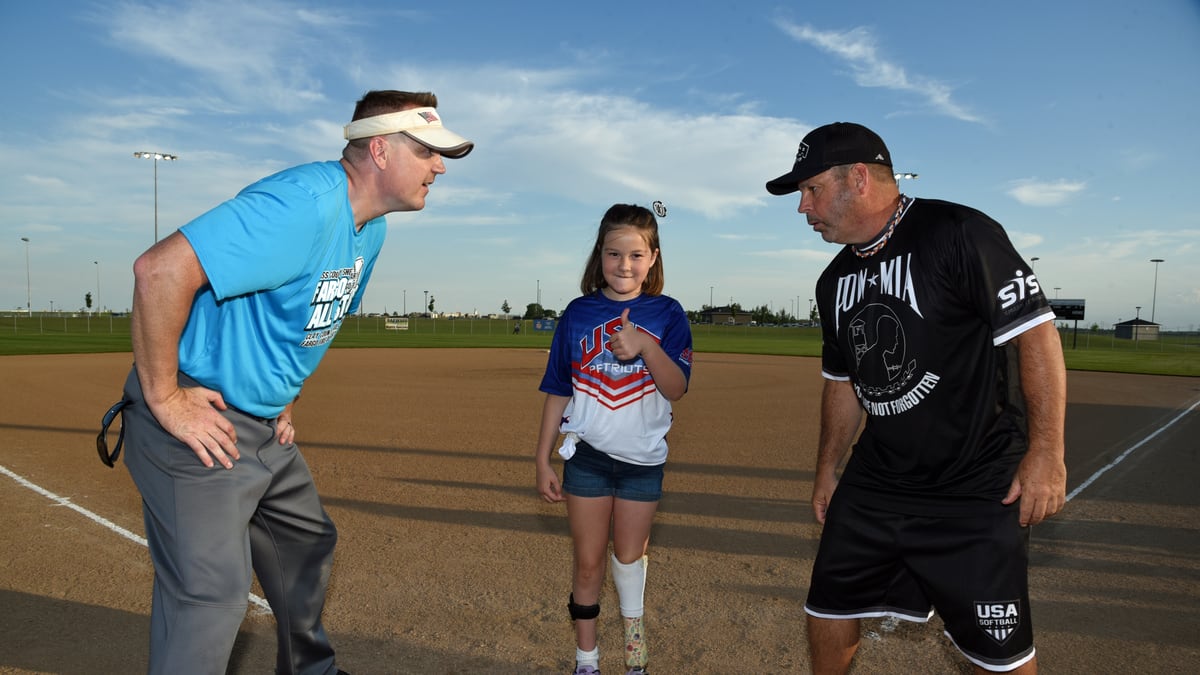
The word “returning” in a headline does a quiet bit of work. It means this has happened before. It means whoever decided to do it the first time thought it was worth doing again. It means Toyota Field in Huntsville, Alabama has had amputee veterans on its diamond at least once, and they’re coming back.
The USA Patriots amputee softball team plays exhibition games at professional baseball stadiums around the country. Their players are wounded military veterans, many of them amputees, and the games combine athletic event with community presence. The Rocket City Trash Pandas, who play Double-A baseball at Toyota Field, are hosting them for what the team describes as an annual appearance. For event-specific details like date and tickets, the 256 Today coverage linked above has them.
If you’ve never seen an amputee play softball at a professional-caliber stadium, in front of a crowd, with a scoreboard overhead, you might be surprised by how unremarkable it looks after the first few minutes. That is the point.
What visibility events actually do
There is a standard critique of adaptive sport events that isn’t entirely wrong: they can drift into inspiration-content territory quickly, where the image of a person with a disability doing an athletic thing becomes primarily useful to nondisabled spectators. They get a moment of feeling moved. The person who had to navigate parking, manage a prosthetic device in the heat all day, and deal with a stadium that was not designed with them in mind is not really in that story.
But that critique can overcorrect. Amputees playing softball in front of a crowd is not automatically inspirational content. It’s also just a crowd seeing people with limb loss doing something. That normalization has a cumulative effect that is harder to measure than a single highlight reel moment. Kids who see it remember it. Adults who live with a family member who has recently had an amputation see it and update their mental model of what comes next. The stakes are not all in the performance; some are in the ambient exposure.
The “returning” part matters more than it might seem. A one-time event is a curiosity. An annual event starts to become part of a community’s regular calendar, which is a different kind of presence.
The veteran frame and what it makes visible
The USA Patriots are a military-affiliated team, which is not incidental. In the United States, wounded veterans have a cultural and media infrastructure around them, and amputee veterans in particular have been a significant presence in adaptive sport coverage for the better part of two decades. The Warrior Games, the Invictus Games, veteran-focused adaptive programs at major sports institutions: this community has built real visibility, and has advocates in places that have resources.
That is a good thing. It is also a frame that does not extend automatically to everyone who has had an amputation.
The majority of amputations in the United States result from vascular disease and diabetes, not combat. The typical person entering the amputee community is not a veteran in their twenties or thirties. They are more likely to be older, dealing with diabetes management alongside limb loss, often with a different support infrastructure and a different relationship to physical activity going forward.
They are not the ones on the diamond when the USA Patriots come to town. That’s not a criticism of USA Patriots; you cannot be every story in one game. But it is worth noting what’s in the frame and what isn’t, because visibility shapes what people understand as possible and what they assume is representative.
What a game doesn’t resolve
After the game, there is still the question of who in Huntsville has access to prosthetics that allow them to be physically active. Whose insurance covered them. What their clinic’s schedule looks like. Whether their residual limb has been stable enough this season to train.
Events like this don’t resolve those questions. They’re not designed to. A softball game is a softball game.
What it can do, when it goes well, is shift a room full of people’s baseline sense of what a life with limb loss contains. Not a cure, not a miracle, not a tearjerker: a baseline. People with amputations are here, doing things, and this particular group does them with some velocity on the ball.
That’s not the whole answer to anything. It is a reasonable thing to do with an afternoon.
Amputee News does not provide individualized medical, legal, or device-fitting advice. For event details including date, time, and tickets, see the source link above.
Source notebook: This reporting draws on 256 Today: USA Patriots amputee softball team returning to Toyota Field for annual Rocket City game, August 2026 ↗. We link out so you can follow the receipts.