
O&P's fabrication side is less visible than its clinical side. Three women working in it describe what getting in actually looked like.
A Q&A in The O&P EDGE asks Patience Nicholls, Kirstin Drexler, and a technician at Shriners Children's Greenville how they entered O&P fabrication, what the credential landscape looks like, and where the field still creates friction.
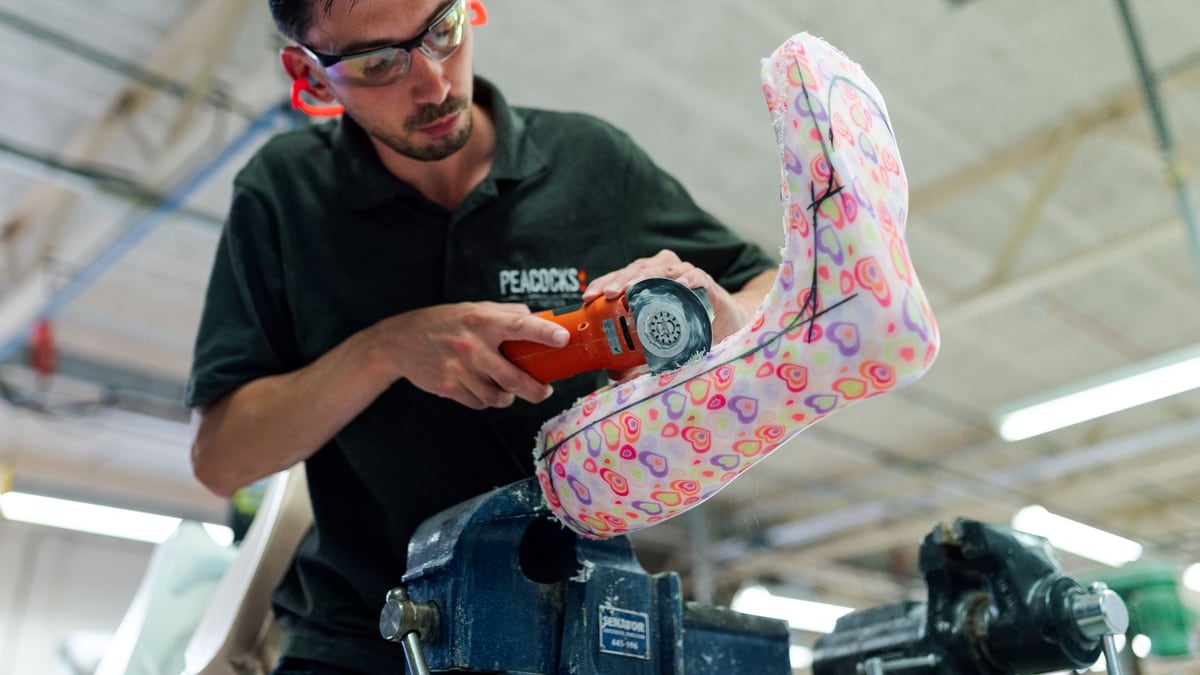
The fabrication side of O&P doesn’t get much coverage. Most reporting about the field tracks the clinical end: prosthetists and orthotists, prior authorization fights, outcome data. The people who build the devices tend to stay in the back room, and most patients, if they think about the field at all, think of the person who fits them, not the person who made the socket.
A Q&A published this week in The O&P EDGE asks three women working in fabrication to describe their paths into the field. None of the three came in the same way, and the contrast between them is more telling than any single story.
Patience Nicholls, CTPO, is an instructional support technician in the O&P Technology program at Spokane Falls Community College in Spokane. She came to the field in 2011 from work as a certified nursing assistant, graduated in 2013, and passed her CTPO exam in 2014. She now works in education rather than clinical practice, which means her current job is helping train the next cohort of technicians.
Kirstin Drexler, CTO, works in pediatric central fabrication at Shriners Children’s Florida. She transitioned from restaurant management and graduated from St. Petersburg College in 2016. She describes fabrication as a combination of artistic skill and healthcare work, which is accurate. Building an orthotic or prosthetic component involves materials, tools, and dimensional judgment alongside enough clinical understanding to know how the finished device will function on a specific body.
Ashley, an O&P technician at Shriners Children’s Greenville, came to the work after her children were grown. She trained on the job at Friddle’s Orthopedic Appliance, where she had known the staff for over 20 years before joining.
What the credentials are
Nicholls holds a CTPO (Certified Technician in Prosthetics and Orthotics); Drexler holds a CTO (Certified Technician in Orthotics). Both come from the American Board for Certification in Orthotics, Prosthetics and Pedorthics (ABC) and require a written exam. The CTPO covers both disciplines; the CTO covers orthotics only. Neither is a clinical credential. Certified technicians build and fit devices under clinical supervision but don’t make independent clinical determinations.
In many practices, this means technicians are part of the team patients never meet or, if they do meet, quickly forget. When the work goes right, the device fits and no one thinks about the person who made it. That invisibility is not a complaint about patients. It is just a description of where fabrication sits in the hierarchy, which is worth naming when the conversation is about who does the work and whether they stay.
What Nicholls described from her early years
Nicholls told the O&P EDGE that she faced intense pressure and expectations that exceeded what her male peers received at the same entry-level stage. She also described encountering harassment and gatekeeping during her first years in the field.
That pattern is not specific to O&P, but it is worth stating plainly in a field that needs people and has limited training infrastructure to replace those who leave. Nicholls stayed and moved into education. The Q&A does not track who didn’t.
What Drexler flagged about female patients
Drexler raised a different issue: the experience of female patients. She noted that fitting approaches developed for or tested on male patients don’t automatically transfer, and that addressing female patients’ needs requires specifically attending to them.
This is a materials and fit question, but it starts earlier, with who is in the room asking it. Fabrication technicians are close to the physical product in ways that can surface that kind of mismatch.
What this means for the field
Three accounts from one Q&A are not a workforce study. But they describe an entry problem and a retention problem sitting next to each other. The routes into fabrication are varied enough that there is no single profile for who gets there, which is genuinely useful for a field that needs more people. The variation doesn’t protect anyone from what Nicholls describes once they arrive.
The fabrication technician training pipeline is thin. Community college programs like the O&P Technology track at Spokane Falls Community College are among the few dedicated credentialing pathways for technicians in the country. The clinical side of the workforce has documented burnout at high rates; the fabrication side is less studied, which is not the same as having fewer problems.
The O&P EDGE’s Tech Talk series puts fabrication workers on the record in a publication mostly read by clinicians and administrators. That is a reasonable use of the format. The question the Q&A doesn’t ask is what the field would need to change to keep the people who come in through all those different doors.
Source notebook: This reporting draws on The O&P EDGE, Tech Talk: Women in O&P Fabrication, September 2026 ↗. We link out so you can follow the receipts.