
IIT Madras researchers recognized for work including prosthetics. The brief they're solving for is different by design.
A Times of India feature highlights IIT Madras professors whose research spans clean water to prosthetics. The prosthetics thread in that recognition sits inside a long tradition of Indian academic work on low-cost, contextually appropriate devices, and a design problem that Western R&D largely didn't set out to solve.
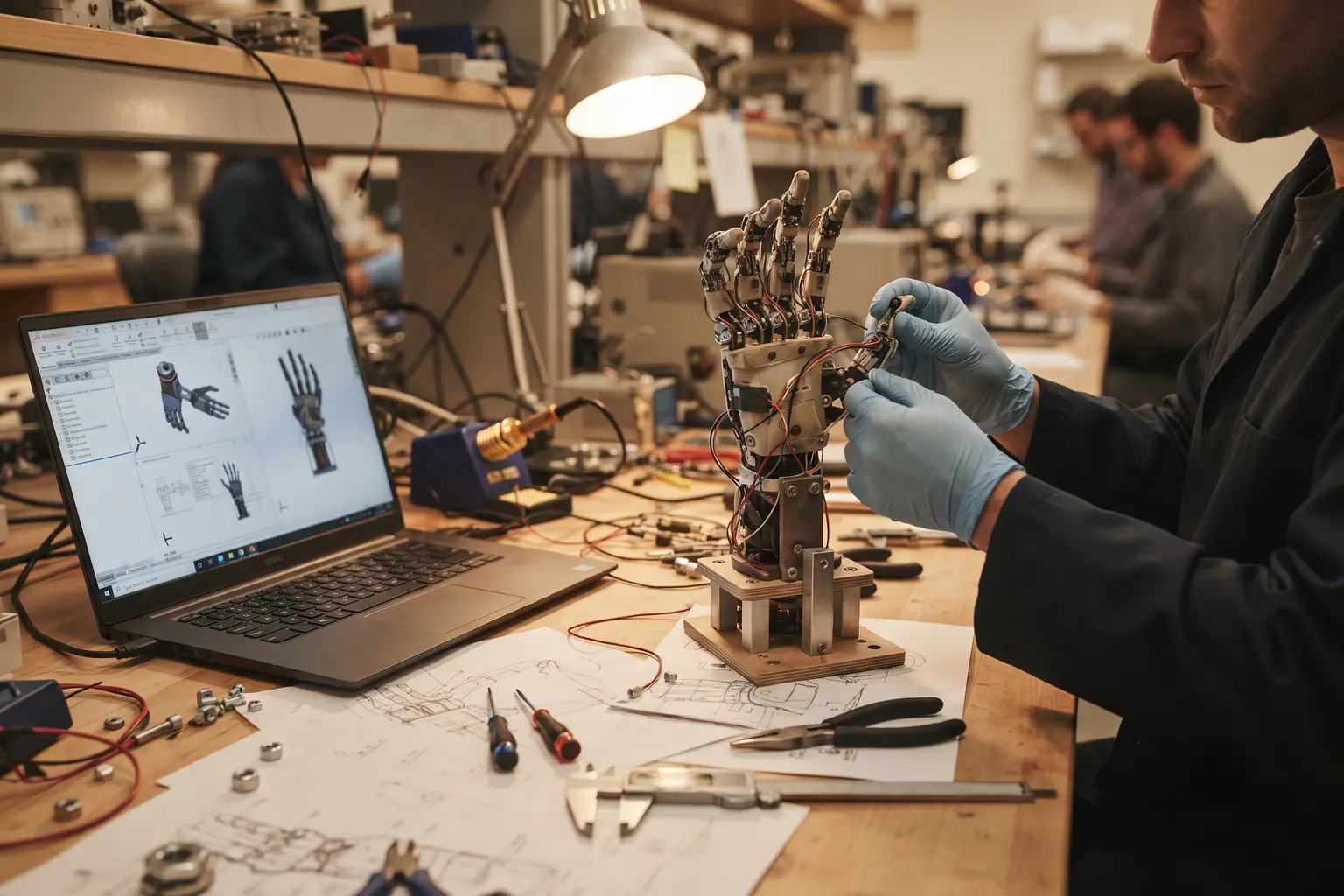
A Times of India feature published August 7 profiles six researchers at the Indian Institute of Technology Madras whose work has earned recognition across a range of fields, including prosthetics. The article is a profiles piece, not a research paper, and the specific prosthetics work it describes isn’t fully detailed in what’s publicly available from the report. But the recognition is a reasonable occasion to lay out the context that makes IIT Madras’s presence in this space meaningful, and why the questions Indian prosthetics researchers have historically asked produce different answers than the ones Western R&D has mostly been working on.
The brief is not the same
Most prosthetic device development over the past several decades has happened in high-income country research centers and commercial settings. Those environments have specific reference users: people who sit in chairs, wear closed-toe shoes, walk on paved flat surfaces, live in temperate climates, and have access to regular O&P follow-up when a device needs adjustment.
That reference user does not describe most of the people in India who need a lower-limb prosthesis.
For the majority of lower-limb prosthesis users in India, particularly in rural and semi-urban settings, daily life involves physical demands that standard Western device design was not built around:
- Sitting positions. Floor-based activities are common: cross-legged sitting, squatting at low heights, kneeling. Most standard prosthetic ankle/foot units are designed for seated use in chairs and walking on grade; they reach mechanical limits quickly in the range of motion required for squatting. A standard energy-storing carbon fiber foot is designed to be worn inside a shoe, which affects its geometry and how it loads. It does not flex to the depth a squat requires.
- Terrain. Rural agricultural work and everyday mobility in many parts of India involves uneven ground, mud, loose soil, and unmaintained roads. Dynamic response feet designed for flat surfaces and jogging tracks have different durability and performance profiles in those conditions.
- Footwear. Much of India’s population goes barefoot or wears sandals and chappals, not enclosed shoes. Prosthetic feet designed specifically for shoe wear, including nearly all high-end energy-storing components, load differently and can fail differently when worn without shoes.
- Climate. High heat and humidity accelerate degradation of certain materials: some socket liner materials soften under sustained tropical heat, adhesives can fail, and electronics in advanced devices require climate management that many households can’t provide.
- Cost. A contemporary Western prosthetic leg, socket, structural components, and foot together, runs $5,000 to $50,000 or more. Median household income in India is around $2,800 per year. The functional target for a usable, durable prosthesis accessible to most of the people who need one in India has consistently been under $100, often under $50.
Those are not variations on the same design problem. They are a different problem. What gets built in response to it looks different.
The Jaipur Foot and what it demonstrated
The most documented example of Indian prosthetics design responding to this brief is the Jaipur Foot, developed in 1968 by orthopedic surgeon Pramod Karan Sethi and craftsman Mahaveer Prasad Sharma at Sawai Man Singh Hospital in Jaipur. Managed by Bhagwan Mahaveer Viklang Sahayata Samiti (BMVSS), it has been fitted to more than 1.3 million people in India and across more than 20 countries.
The engineering decisions in the Jaipur Foot were not compromises on a Western design. They were specifications written for the actual user. The foot uses a rubber construction with an embedded fiber core that allows meaningful plantar flexion, enough for squatting, as well as inversion and eversion that helps on uneven ground. It is designed to be worn barefoot. It is durable under load and field conditions. Its cost is roughly $45 to $75 per foot, which BMVSS further subsidizes or provides without charge to patients who cannot afford it.
The Jaipur Foot also became a subject of academic research. Various IIT institutions, including Madras, have collaborated on or contributed to analysis of its biomechanics, socket design, gait performance, and subsequent iterations. That relationship between academic research and the actual deployed device is one of the things that distinguishes Indian prosthetics R&D from a pure lab-science exercise: there is a live system, reaching a large population, that research institutions can study, improve, and extend.
What IIT Madras represents in this lineage
IIT Madras is one of India’s premier technical institutions. Its departments in mechanical engineering, biomedical engineering, and applied sciences have published research on prosthetic gait dynamics, socket design, and low-cost assistive devices. Its Centre for Healthcare Technologies has been one of the organizational homes for work on rehabilitation engineering and human movement.
What academic recognition of prosthetics work at IIT Madras signals, against that background, is that the research is landing, meaning it’s generating enough output, enough methodological rigor, and enough visibility that it merits the kind of institutional profile that Times of India provides. That is a soft signal, but it’s not nothing: research traditions at technical institutions depend partly on whether the next generation of engineering students sees prosthetics as a serious, recognized field worth going into.
The specific work highlighted in the Times of India feature isn’t detailed in available reporting, and that limits what can be said about it directly. The broader frame is more stable: IIT Madras has a history in this space, the design problem is real and large, and recognition from a mainstream publication can push more graduate students and more funding toward problems that the market alone won’t prioritize.
The access numbers
The World Health Organization estimates that roughly 40 million people globally need a prosthesis or orthosis but cannot access one. The majority of that gap is in low- and middle-income countries. India represents a significant share.
Road traffic crashes are the leading cause of traumatic limb loss in India, which has one of the highest road mortality rates in the world by absolute numbers. Diabetes is a major and growing cause of lower-limb amputation; India has the world’s second-largest diabetic population, with roughly 77 million people currently living with the disease, and amputation rates associated with diabetic foot complications are climbing as care pathways fail to catch and manage the risk early. Agricultural machinery injuries and infectious disease complications round out the burden.
India’s certified O&P workforce, prosthetists and orthotists with formal clinical training, is thin by any measure relative to population. Government programs including the ADIP scheme (Assistance to Disabled Persons) subsidize device procurement, and some non-governmental organizations run fitting camps at scale. But individualized clinical follow-up, the kind that adjusts a socket when a residual limb changes, or catches a gait problem before it becomes a back or hip problem, is not broadly available.
The gap between the number of people who need a device and the number who receive adequate care is not primarily a manufacturing gap. It is a workforce, infrastructure, and economic gap that manufacturing solutions alone cannot close. Which is, notably, the same caveat that applied to the UNIDO/IfeanHealth programme in Nigeria we covered earlier this week.
From recognition to reach
The question academic recognition tends not to answer is the one that matters most for the people in the access gap: how does a research finding that works in a Madras lab reach a person who needs it in Tamil Nadu’s Nilgiris district, or in Rajasthan, or in Bihar?
That distance involves manufacturing, distribution, clinical training, and the continuing care that keeps a device useful after it’s fitted. Indian academic R&D has historically been good at developing the device and less systematic about solving the pipeline. The Jaipur Foot is the partial exception: BMVSS built the distribution and fitting infrastructure alongside the device, and it remains the exception for a reason. Building the pipeline requires institutional will and sustained funding that a research recognition doesn’t generate.
What it can generate is visibility. Recognition that reaches students, funders, and policy planners shapes what gets resourced next. In a field where the number of people working on contextually appropriate low-cost devices is small relative to the need, that has value.
What to watch
The Times of India piece tells you there are IIT Madras researchers whose prosthetics work is being recognized. It doesn’t tell you whether that work is in materials science, clinical biomechanics, socket fabrication methods, digital design tools, or some combination. The peer-reviewed publications from this group, which will carry the methods, validation data, and scope, are the documents that will establish what’s actually being contributed and how close it is to deployment.
For people following prosthetics access in the Indian context specifically: the indicators worth watching are whether Indian government programs like ADIP begin integrating newer locally developed device designs, whether the O&P workforce training infrastructure at Indian institutions expands to close the clinical gap, and whether international development bodies working in this space engage Indian academic R&D as a source of regionally appropriate design rather than importing Western device standards.
Amputee News does not provide individualized medical or fitting advice. Device suitability depends on individual clinical assessment by qualified practitioners. The access statistics cited here reflect WHO and published epidemiological estimates as of available reporting; precise national figures vary by source and methodology.
Source notebook: This reporting draws on The Times of India: From clean water to prosthetics, six IIT Madras professors whose life-changing research earned recognition, August 7, 2026 ↗. We link out so you can follow the receipts.