
RIT researchers combined bioprinting and embedded sensors in a prosthetic prototype. Here is what they built and what is still unresolved.
A Rochester Institute of Technology team published a proof-of-concept prosthetic integrating hybrid materials, extrusion-based bioprinting, and piezoelectric tactile sensors. The device is a research prototype, not a clinical product.
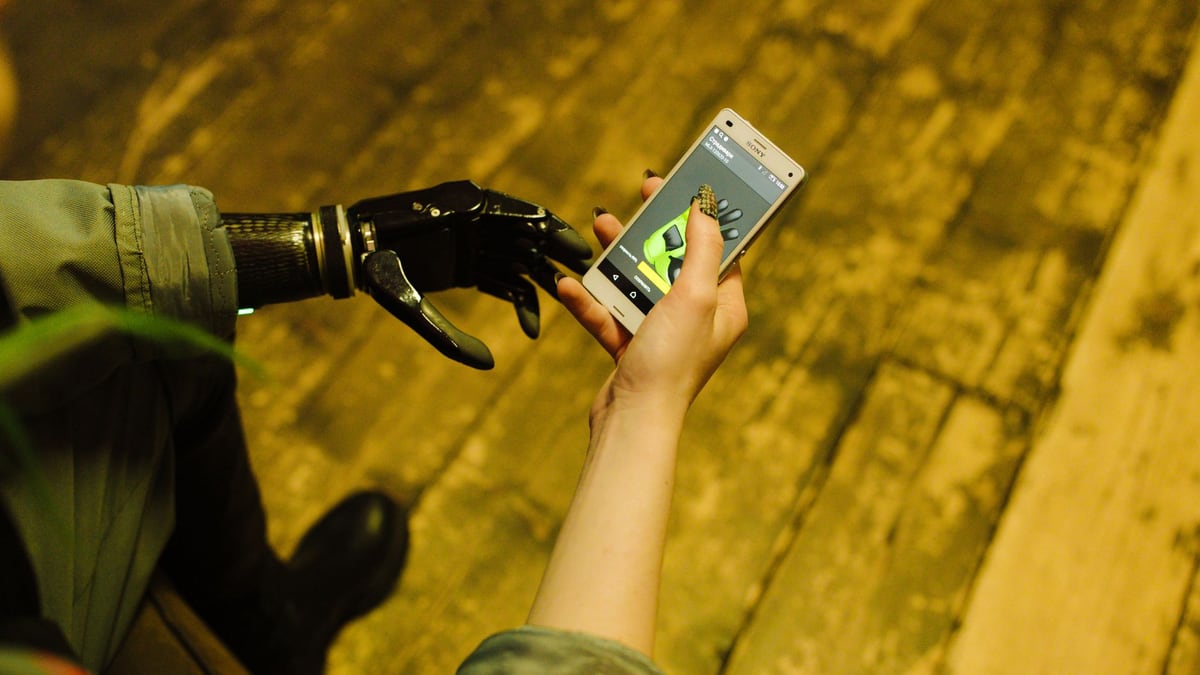
Researchers at Rochester Institute of Technology published a paper describing a finger and hand prosthetic prototype that integrates four technical approaches prosthetics research has typically addressed separately: hybrid materials, extrusion-based bioprinting, piezoelectric sensing, and mechanical design. The study appeared in the Journal of Manufacturing and Materials Processing.
The team included Salman Pervaiz, Krittika Goyal, Jun Han Bae, and Ahasan Habib, working across RIT’s Rochester and Dubai campuses. The paper’s argument is that treating materials, fabrication, sensing, and structure as isolated research tracks has left fit consistency, durability, and tactile feedback as recurring unsolved problems. The prototype attempts to address all four in one design cycle.
What they built
The prototype uses PLA (polylactic acid) for the rigid skeletal structure, printed using fused deposition modeling (FDM) and stereolithography (SLA). PLA offers dimensional accuracy and low cost, but the team noted its limited impact resistance and compensated through infill geometry rather than a different base material.
The sensing layer is polydimethylsiloxane, a silicone compound, applied to the SLA-printed structure through extrusion-based bioprinting. PDMS is flexible and biocompatible, which is why the team selected it for elements that contact the user or interface with soft tissue. Bonding it to the rigid SLA structure is described as functional for the prototype; long-term durability under sustained mechanical stress is flagged as untested.
The sensors are piezoelectric: they generate electrical signals under mechanical pressure. In a prosthetic context, this means the device produces a signal when it grips or contacts an object, which could be routed back to the user as tactile feedback. The current implementation does not yet include real-time joint movement tracking; the team lists that as future work.
The problem they were working on
Prosthetics research tends to divide. One group works on materials and print quality, another on sensing and actuation, another on socket fit and mechanical durability. The RIT group’s argument is that this division means improvements in one area do not transfer automatically to devices that work better for patients, because the integration problems across areas remain unaddressed.
Researcher Ahasan Habib described the underlying gap: “One of the greatest needs in prosthetics is the ability to produce patient-specific devices that closely match an individual’s anatomy, mechanical properties, and functional requirements.”
Pervaiz framed the two goals the team was pursuing: “The first was to bring together multi-material printing, so it’s not like the whole prosthetic should be printed with one material. The second was to make it smart, so it can be used not only for gripping but other functions.”
What this means, and what it does not
The device described is a research prototype. It does not exist as a product and the paper does not claim a clinical readiness timeline. The research-to-clinical distance for a device of this type is substantial: prototype validation, biocompatibility testing for materials in contact with residual limb tissue, sensor durability under real-use conditions, regulatory clearance for a device that generates and processes electrical signals, and clinical trials supporting any functional claims.
What the paper contributes is a documented attempt to combine fabrication methods, material types, and sensing in a single design cycle. If the PDMS-SLA bonding approach can be made durable under sustained stress, and if the piezoelectric sensing layer can be refined to track joint movement in real time, those would be concrete steps toward prosthetics that are both customizable and capable of providing feedback to users.
Both of those are stated in the paper as open research questions, not solved problems.
The broader claim in the literature is that additive manufacturing could lower the cost of custom-fit devices substantially by removing per-unit mold costs. That claim has real support, and this paper is in that conversation. But fabrication cost is one constraint among several. Insurance coverage, prosthetist availability, fitting and follow-up care, and replacement cycles are all part of why device access is limited. A cheaper prototype does not change most of that.
The useful question this research leaves open is whether the combined-disciplines approach produces better devices at the prototype stage, and whether that holds when materials are tested under the conditions of actual use rather than controlled fabrication.
Amputee News does not provide individualized medical or device advice. Prosthetic device options depend on amputation level, residual limb anatomy, functional classification, payer coverage, and clinical assessment. Research prototypes described in this article are not available as clinical or commercial products.
Source notebook: This reporting draws on 3D Printing Industry: Bioprinting and Smart Sensors Converge in New RIT Prosthetic Prototype (August 2026) ↗. We link out so you can follow the receipts.