
The O&P EDGE asked who builds the devices. It is a more interesting question than it first sounds.
O&P EDGE's Tech Talk series spotlights women in prosthetic and orthotic fabrication, featuring Patience Nicholls, CTPO, at Spokane Falls Community College. What fabrication technicians do, what the CTPO credential covers, and why this part of the workforce rarely shows up in the story.
This coverage has been consolidated: see our full piece on O&P’s fabrication side: three women describe what getting in actually looked like, which covers all three Q&A subjects and includes expanded context on training infrastructure and workforce dynamics.
The device on your leg, or your arm, was built by someone. Not the person who fitted it, whose name is on your chart and who you call when the socket starts rubbing. A different person, working in a lab, with carbon fiber and thermoplastic materials and resin, who put the physical thing together before the appointment that matters to you happened.
The O&P EDGE’s Tech Talk series features fabrication professionals talking about their work. This week’s entry spotlights women in O&P fabrication, with Patience Nicholls, CTPO, instructional support technician in the O&P Technology program at Spokane Falls Community College (SFCC), describing how she found the field at age 20. The full piece is worth your time.
It is also an occasion to think about what fabrication actually is, because many people who use prosthetics have only ever encountered the clinical side and don’t know the other side exists.
What fabrication technicians do
When you see a prosthetist, you see a clinician: someone who evaluates your residual limb, determines what you need, takes measurements or scans, manages the fitting, and adjusts things when they are off. That is one job.
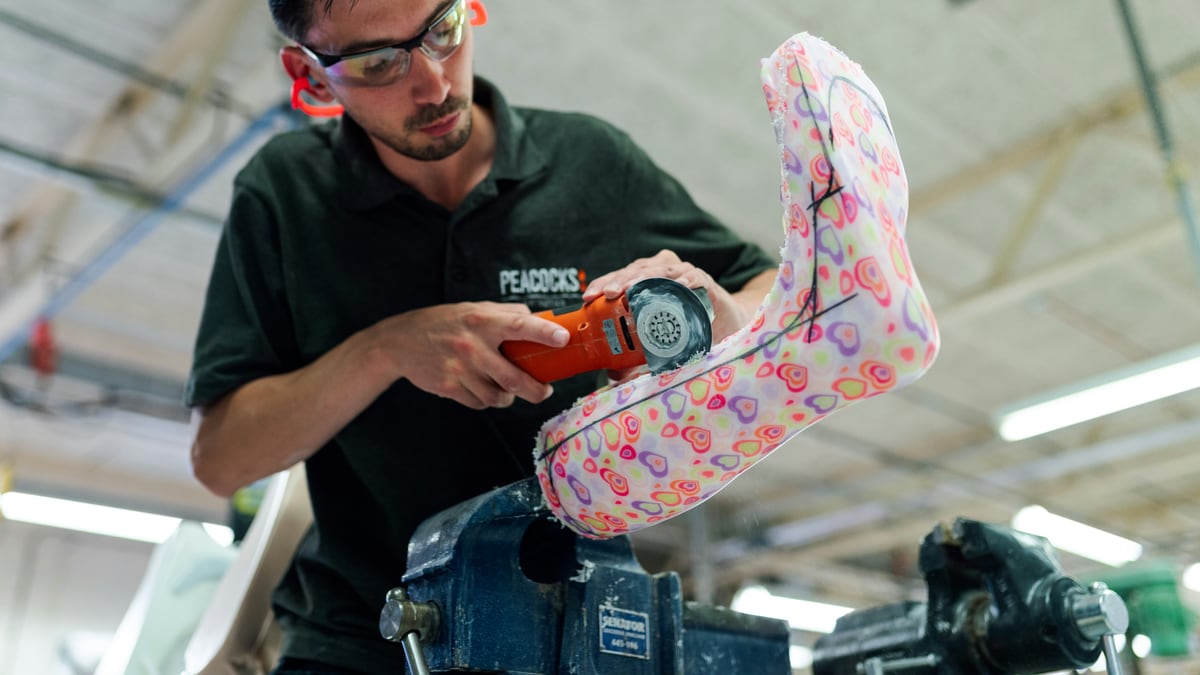
The device itself is a different job. Fabrication technicians work with carbon fiber, thermoplastics, silicone, resins, and mechanical components. They laminate sockets, trim and finish liners, assemble joints, and build the physical object that the clinician then fits to a person. It is skilled trade work: materials handling, hand skills, quality control. A lot of it is invisible to the person wearing the result.
The professional credential for this work in the United States is the CTPO, Certified Technician in Prosthetics and Orthotics, administered by the American Board for Certification in Orthotics, Prosthetics and Pedorthics (ABC). The CTPO requires documented lab experience and a written examination. The training pathway is distinct from becoming a prosthetist or orthotist, which takes a graduate degree, a supervised clinical residency of at least one year, and board certification exams. A technician’s pathway is shorter and more often runs through community college programs, which is where SFCC comes in.
Who gets trained to do this
SFCC’s O&P Technology program is one of a small number of dedicated technician training programs in the country. Nicholls’s role as instructional support technician means she trains the people who will build the next generation of devices. A single practitioner in that position shapes multiple students at a time, on a timeline that a graduate clinical program cannot match.
The O&P field has documented workforce supply problems. Research published earlier this year found high rates of burnout among clinical practitioners, a finding with real consequences in a small field where losing one practitioner can reshape access across a region. The fabrication workforce is a less-studied part of that picture. Someone still has to build the devices, and they need to be trained to do it. Community college programs that specifically credential this track are one of the few places that pipeline actually runs.
Who is in this room
The Tech Talk feature asks who is in the fabrication workforce and what drew them there. That is a question the field does not raise loudly or often.
A prosthetist’s name goes on your chart. A fabrication technician’s name goes on none of the paperwork that follows you through the system. Knowing who fills that role, and what the pathways into it look like, is part of understanding how the device in front of you came to exist. O&P EDGE is asking the question. It is worth pausing on the answer.
Source notebook: This reporting draws on The O&P EDGE: Tech Talk, Women in O&P Fabrication, September 2026 ↗. We link out so you can follow the receipts.