
A prosthetic socket sensor that adapts its warning threshold the way a pain response does
Researchers at Zhejiang University of Technology tested a bioinspired pressure sensor with three transtibial amputees. The most practically useful result came from the running test.
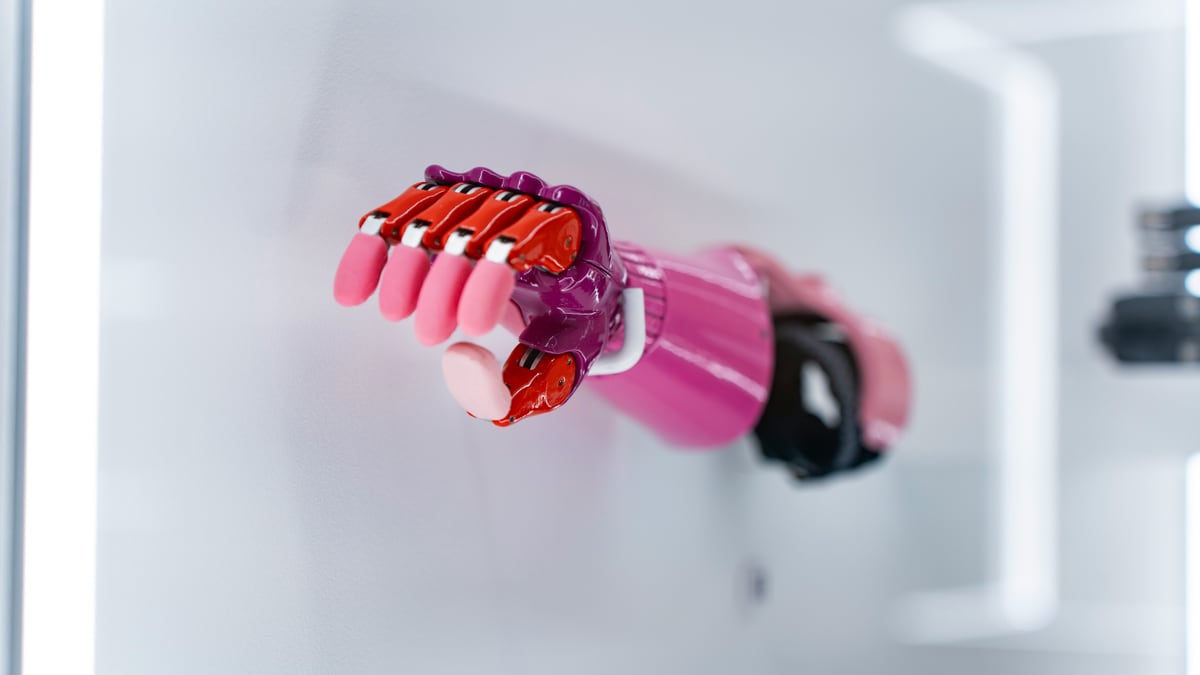
A research team at Zhejiang University of Technology has tested a pressure sensor designed to attach to a prosthetic socket and track where, how hard, and how long the socket presses against the residual limb. The device copies some features of how the body’s pain response works: it becomes more sensitive to a given pressure level once it has detected that same pressure held long enough to register as potentially harmful.
The study, published open-access in Cyborg and Bionic Systems, describes testing on a robotic prosthetic hand and with three people with transtibial amputations during sitting, walking, stair climbing, jumping, and running.
How the sensor works
The device uses two signal pathways. One delivers fast feedback on where pressure is located and how intense it is. The second accumulates readings across time and across multiple contact points, building a pattern the way pain signals stack up under prolonged stress.
The adaptive threshold is the part worth understanding. At 10 kilopascals applied for 0.21 seconds, the system logged the pressure as harmless. The same pressure held for 0.49 seconds registered as potentially harmful. After that longer contact event, the system’s response to the same pressure level became faster than it had been before. Huaping Wu, PhD, mechanical engineer and senior author, described it this way: “The device neither feels pain nor creates pain in the user. Instead, it reproduces selected information-processing features associated with nociception, including stimulus thresholds, temporal and spatial summation, memory, and sensitization.”
The “memory” here is an engineered change in the warning threshold based on previous inputs, not anything cognitive.
The gait finding
The most useful result in the paper came from the running test, not the static or lab portions. During running, the sensor detected that participants were compensating with an excessive hip hike to clear the prosthesis from the ground. That pattern was producing uneven socket loading and increased pressure at the front of the residual limb.
Hip hike is a common compensatory gait pattern in lower-limb prosthetic users, sometimes present without the person being aware of it. Its downstream effects on the residual limb and on the opposite hip are a known concern in rehabilitation. The sensor flagged it as an objective pressure event rather than something a clinician would need to observe visually or a patient would need to report by feel.
The researchers think this type of feedback could support both socket fitting and gait retraining. The system can issue warnings that prompt a user to shift position, rest, or have the socket checked. In a fitting session, it could give a prosthetist a pressure map across activities rather than relying on the user’s verbal account of where it feels wrong during a static appointment.
What this means
The combination of real-time pressure data and gait feedback addresses something current socket monitoring handles poorly: damage that develops before the person wearing the prosthesis feels it clearly. The connection between socket pressure and skin breakdown is well documented, and undetected loading problems are a regular source of wound, missed wear time, and unplanned clinic visits. Most current monitoring depends on user pain reports, which are unreliable on their own because residual limb sensation varies and because skin breakdown can progress well before it becomes painful.
This study is preclinical in scale. Three participants is not enough to know how well the approach generalizes across body types, activity levels, or limb presentations, or how the threshold calibration holds over time and across sweat, temperature, and volume fluctuations. The research team’s stated next step is translation toward clinical practice, which means regulatory review, larger trials, and integration with existing socket designs, none of which are near-term.
The gait feedback angle is the piece with the clearest near-term path, since real-time pressure data across activities is useful in a rehabilitation or fitting context whether or not the adaptive threshold feature eventually makes it into a wearable consumer device.
This article covers research findings. It is not clinical advice. If you have concerns about socket fit, skin integrity, or gait patterns, consult your prosthetist or rehabilitation team.
Source notebook: This reporting draws on The O&P EDGE: Prosthetic Sensor Identifies Pressure Before Injury, September 2026 ↗. We link out so you can follow the receipts.