
A Palestinian amputee wants to build a football team in Pakistan. The sport has been built this way before.
Arab News Pakistan reported this week on a Palestinian footballer who lost his leg and is trying to establish an amputee football program in Pakistan. An orientation to the sport, how it spreads to new countries, and what building something from the ground up actually involves.
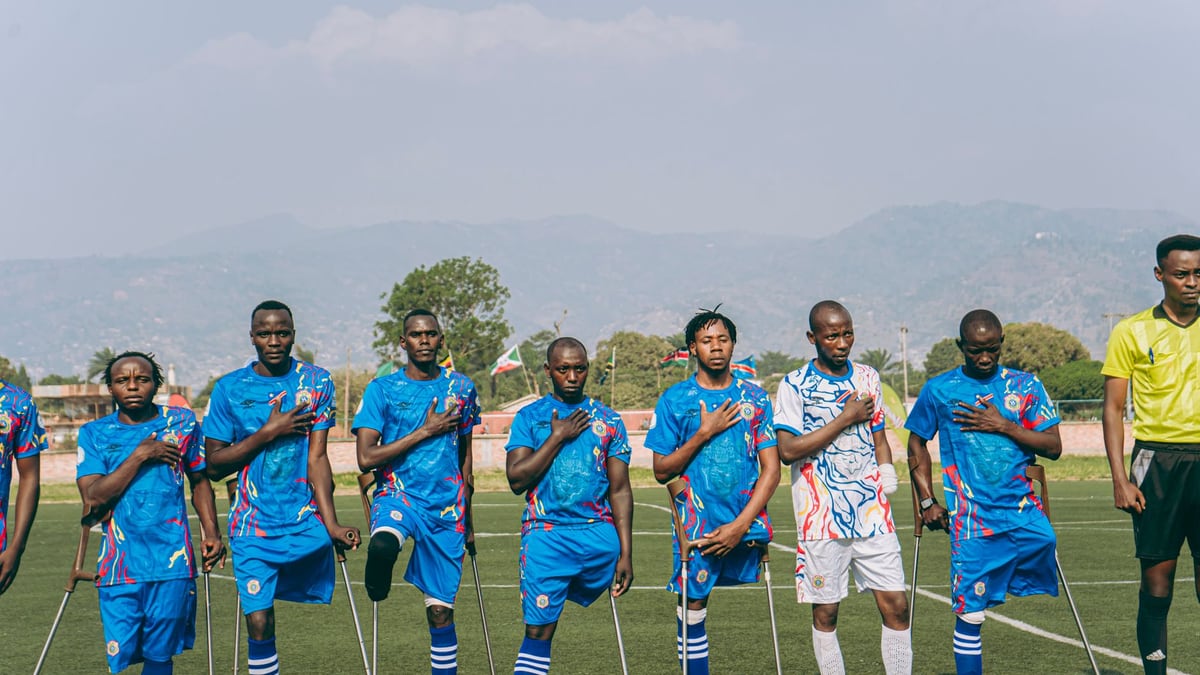
Arab News Pakistan reported this week on a Palestinian footballer who lost his leg and is trying to establish an amputee football program in Pakistan. Read it for the individual story. It is also a recognizable kind of story for a sport that has been built from scratch, by people who needed it to exist, in dozens of countries over the past three decades.
The sport is worth knowing on its own terms.
What amputee football is
Amputee football is played seven-a-side on a grass pitch. Field players have a lower-limb amputation or significant limb difference and use forearm crutches throughout the match. No prosthetic device is worn during play. The goalkeeper position is for a player with an upper-limb amputation or significant difference; they play without crutches.
It is a fast, physical game. Crutch handling, upper-body stamina, and lateral movement on uneven ground are central skills. It is not a therapeutic version of football. It is a competitive sport with its own technical demands, and watching it for the first time, people typically expect to feel something like sympathy. What they usually report is that the sympathy goes away once the match starts.
The international governing body is the World Amputee Football Federation. FIFA has worked with the federation on the sport’s international development and recognition. The Amputee Football World Cup runs every two years. Turkey has been among the most competitive national programs in the sport.
Where it keeps appearing
Amputee football has spread in regions with high rates of conflict-related limb loss. West African programs, particularly in Ghana and Nigeria, developed through the 1990s and 2000s. Brazil built one of the more competitive programs in the Americas. Ukraine’s program grew significantly after 2022. Syria, Iraq, and parts of the broader Middle East have had players involved at various points, partly through diaspora connections, partly through programs built close to the conflict itself.
Ghana’s program has been among the more organized in Africa, though it spent years in a governance dispute that a court only resolved this year. We covered that case when it landed. The story illustrates something true across the sport: building something is the easier part. Sustaining it through administrative structures that don’t collapse is harder.
Gaza specifically has had connection to amputee football. Palestinian amputees, including those injured in successive rounds of conflict since 2008, have played football as an organized activity. Whether they accessed formal World Amputee Football Federation-affiliated competition consistently is harder to document, but players have been there.
Pakistan is a different situation. The country does not have the kind of organized amputee football infrastructure that Turkey or Ghana have built. That does not mean there are no players. There are people in Pakistan who have had lower-limb amputations, from accidents, from disease, from whatever particular path brought them there. It means there is no established club structure, no domestic competition, and no clear pathway toward international affiliation without someone doing the organizational work to build one.
The Palestinian footballer Arab News covered is trying to do that work.
What building something actually takes
Starting an amputee football program in a country without one follows a fairly consistent sequence. Someone finds other amputees who want to play. This usually happens through clinics, through disability sports networks, through community connections, or just through asking around. A few players start training. Someone registers a formal organization. That organization contacts the World Amputee Football Federation to establish affiliation, which requires a basic organizational structure and documented player registration.
None of that is fast. The sport has no shortage of examples of people who spent years on the administrative side before a team took a first competitive step.
What it usually requires, specifically, is one person who has seen the sport exist somewhere and is convinced it should exist here. That person is often someone who played before their amputation, someone who played after it, or someone who watched and thought: this should be available where I live. They do not need capital. They need patience and the knowledge that an international structure exists to receive what they are building.
For the Palestinian footballer the Arab News covered: what he wants to build in Pakistan has been built before, in harder circumstances. That is not a prediction. It is a description of how the sport arrived everywhere it now exists.
Source notebook: This reporting draws on Arab News Pakistan: From Gaza to Pakistan, Palestinian footballer who lost leg dreams of amputee team ↗. We link out so you can follow the receipts.