
Microprocessor prosthetic knees: what they do, who qualifies, and how coverage works
A practical guide to microprocessor-controlled prosthetic knees for above-knee amputees: how they differ from mechanical knees, K-level prerequisites for Medicare coverage, prior authorization requirements, and what to do when a claim is denied.
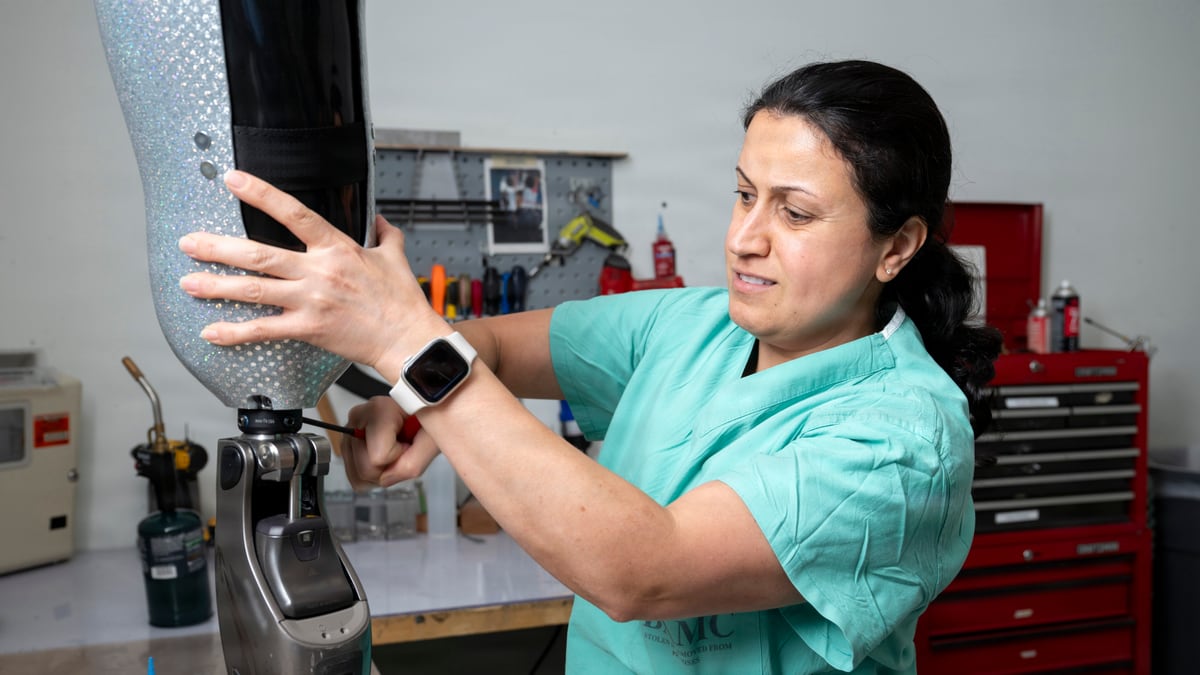
A mechanical prosthetic knee works by setting resistance. The prosthetist calibrates swing phase behavior during fitting, and it stays there. It does not know whether you are walking downhill, stumbling on a curb, or crossing a parking lot that slopes slightly toward the drain. You compensate with hip strength and residual limb control.
A microprocessor prosthetic knee reads what is happening and adjusts. That is the practical difference.
This guide covers how microprocessor knees work, what K-level you need to qualify for one under Medicare, what the prior authorization process looks like, what coverage actually pays, and what happens when it does not.
How microprocessor knees work
The mechanical problem with any above-knee prosthesis: the knee joint has to resist buckling when you load it during stance phase, but has to swing freely during the step cycle. A simple mechanical knee sets resistance at a fixed level, which is always a compromise. Walk faster and the fixed swing phase feels wrong. Walk on a slope and the resistance that works on flat pavement does not work there.
A microprocessor knee uses sensors to sample joint angle, angular velocity, and in some devices ground reaction forces, continuously at rates of dozens to hundreds of times per second. A processor running on that data adjusts resistance in real time, through one of several mechanisms depending on the device.
In practical terms, this means the device responds differently to a stumble than a mechanical knee does, because it detects the abnormal loading pattern and stiffens before the joint buckles. It means you can walk at variable speeds without manually adjusting. It means descending stairs foot-over-foot is possible for some users, where a mechanical knee makes that difficult or creates fall risk.
The specific capabilities vary by device and by the user’s functional level. A microprocessor knee is not the same as a bionic leg; it is a passive device with computer-controlled resistance.
Devices currently in the US market
Three major types are in common clinical use in the United States.
Hydraulic microprocessor knees use a computer-controlled hydraulic valve to manage both stance and swing phase. The Ottobock C-Leg, introduced in the late 1990s, is the most widely documented device in the clinical literature. Ottobock’s Genium adds activity recognition that adjusts the knee’s behavior based on detected context, such as stair descent or ramp walking. The X3 is a waterproof variant designed for swimming and water exposure. These are distinct devices, not software updates to the same hardware.
Magnetorheological knees use a fluid whose viscosity changes when an electrical current is applied. This allows resistance changes that are faster than hydraulic valve actuations. Össur’s Rheo Knee series is the primary device in this category in the US; the current model is the Rheo Knee XC.
The Fillauer Plié 3 is a hydraulic microprocessor knee with a different actuation design and a published weight lower than the C-Leg series.
There are also powered (motorized) knee units, including Össur’s Power Knee and Ottobock’s Kenevo. Powered knees generate motion actively rather than only controlling resistance. They have different functional profiles and different insurance pathways. This guide covers passive microprocessor knees, which are the standard category for most above-knee prosthetic users.
K levels and who qualifies
Medicare’s K-level system classifies prosthetic users by rehabilitation potential and uses that classification to determine which components Medicare will cover. The five-level scale runs from K0 (no ambulation potential) to K4 (high-activity ambulation, including sports and physical labor).
For microprocessor knees, the coverage threshold under Medicare’s Local Coverage Determination (LCD L33944) is K3. K3 is community ambulation: the ability to walk at variable cadence and to traverse low-level environmental barriers such as curbs, stairs, and uneven terrain. K4 is also covered.
K2 is household ambulation with limited community traversal. LCD L33944 does not cover microprocessor knee components at K2. The clinical argument that an MPK might reduce fall risk for a K2 ambulator does not change what the LCD requires. If your assessment places you at K2, the coverage argument has to happen at the level of the K-level designation itself, not the component. Getting a K2 reassessed to K3 requires documented functional progress and a new clinical evaluation.
Private insurance plans often follow the same K-level logic but are not bound by LCD L33944. Some commercial plans cover MPKs at K2 with additional documentation. Others mirror Medicare exactly. Your Certificate of Coverage controls this, not the general rule.
For new amputees: the K-level assigned at initial fitting is a prediction of rehabilitation potential, not a permanent status. If you are assessed at K2 but develop K3-level function through rehabilitation, the K-level can be revised. That revision requires documentation from your care team and a new functional assessment. The guide on K levels and what they actually control covers that process in more detail.
Medicare prior authorization
Medicare requires prior authorization for microprocessor knee components before a claim can be submitted. This applies to HCPCS codes L5856 (microprocessor knee with stance and swing phase control) and L5857 (stance phase control only). Authorization requests go through the Medicare Administrative Contractor (MAC) for your geographic region.
A prior authorization submission for an MPK typically requires:
A letter of medical necessity (LMN) from the prescribing physician documenting the functional classification, the clinical basis for the K3 or K4 designation, and why a standard mechanical knee is not adequate for the patient’s rehabilitation goals.
A prosthetic evaluation from a certified prosthetist (CPO or LPO) documenting current functional status, gait analysis findings, fall history if applicable, and the specific device being requested with its HCPCS code.
Functional outcome documentation using standardized assessments. The 2-Minute Walk Test, Timed Up and Go, and the Medicare PLUS assessment are commonly used. The LMN needs to connect the assessment scores to K3 functional criteria as defined in the LCD.
MACs are supposed to respond within 10 business days for standard requests and 2 business days for expedited requests based on urgent clinical need. In practice, requests often require clarification rounds before approval, which extends timelines.
A prior authorization approval does not guarantee payment. It means the documentation met the threshold to proceed. The claim can still be denied at adjudication if the service provided differs from the authorization or if the MAC reviewer disagrees on a clinical detail.
Your prosthetist’s track record with MPK prior authorizations matters here. If they have processed multiple MPK authorizations with the same MAC, they will know what that MAC’s reviewers typically require. Ask how many MPK prior authorizations they have handled in the last year and what the approval rate was.
What Medicare pays
Medicare Part B covers prosthetic devices at 80% of the allowed amount, after the Part B deductible. You pay the remaining 20%.
The allowed amount for L5856 and L5857 is set by the DMEPOS fee schedule, which varies by geographic region. Fee schedule amounts for microprocessor knees are substantially lower than retail acquisition costs for most name-brand devices. The result is that most contracted prosthetists accept assignment and bill the Medicare fee schedule rate. Your 20% of that fee schedule amount is still several thousand dollars for most MPK devices.
Prosthetists who do not accept assignment (non-participating providers) can charge up to 115% of the Medicare allowed amount, and your out-of-pocket liability increases accordingly.
Medigap (Medicare supplement) plans generally cover the 20% cost-sharing, depending on plan type. Medicare Advantage plans have their own cost-sharing structures and prior authorization requirements, which may differ from Original Medicare even when the underlying coverage rule is nominally the same. The Medicare vs. Medicare Advantage guide covers those differences.
Private insurance
Private insurance does not use the Medicare fee schedule, and coverage varies more widely. Some commercial plans cover MPKs with prior authorization under functional-classification logic similar to Medicare’s. Others require step therapy: you must document inadequacy with a standard mechanical knee before they will authorize a microprocessor device.
Many states have prosthetic parity laws requiring private insurers to cover prosthetics at a level functionally equivalent to what Medicare covers for an equivalent functional status. Whether that standard requires MPK coverage at K3 is often the specific point of dispute.
The prosthetic parity laws guide covers the state-by-state variation.
When a claim is denied
MPK denials usually fall into a few categories. Functional classification denial: the reviewer disagreed with the K3 designation. Component denial: the reviewer accepted the K level but denied the specific device as not medically necessary for that patient. Incomplete documentation denial: the required elements were not present in the submission.
For Medicare, the appeal process has five levels: redetermination (through the MAC), reconsideration (through the Qualified Independent Contractor, or QIC), Administrative Law Judge (ALJ) hearing, Medicare Appeals Council, and federal district court.
ALJ hearings allow you or your prosthetist to present clinical testimony, and they have historically had higher overturn rates than the earlier administrative levels. The realistic caveat: the ALJ backlog at CMS means hearings can take a year or more to schedule.
At the redetermination and reconsideration levels, adding updated functional documentation, peer-reviewed literature supporting MPK outcomes at your functional level, or a second clinical opinion can strengthen the record. A denial at one level does not close off the process.
The how to appeal a denied prosthetic claim guide covers the appeals process step by step.
Questions for your prosthetist
Before the prior authorization process starts, your prosthetist should be able to answer these:
Which device are you recommending, and what is the clinical reasoning for that device given my functional level and anatomy?
What K-level are you documenting, and what functional assessments support it?
Which MAC covers our region, and what has their MPK prior authorization process looked like in your experience?
What does the total cost look like, including the device, fitting, and follow-up adjustments, and how does that break down between what my insurance pays and my out-of-pocket share?
What does the device warranty cover, and what is the repair and replacement process if a component fails?
The answers to these questions do not make the decision for you, but they tell you whether the process ahead is well understood by the people guiding it.
Medical information disclaimer: This guide describes coverage policy and general clinical information for educational purposes. It is not medical advice, device-fitting guidance, or a clinical recommendation for any individual. Your K-level assessment, the devices appropriate for your anatomy and activity level, and your coverage eligibility depend on factors specific to you and should be determined by your care team.
Source notebook: This guide draws on Amputee Coalition limb loss resources ↗. We link out so you can follow the receipts.