
Finding peer support without joining a motivational cult
A low-pressure way to find people who understand limb loss, figure out what kind of support you actually want, and leave if a space is not for you.
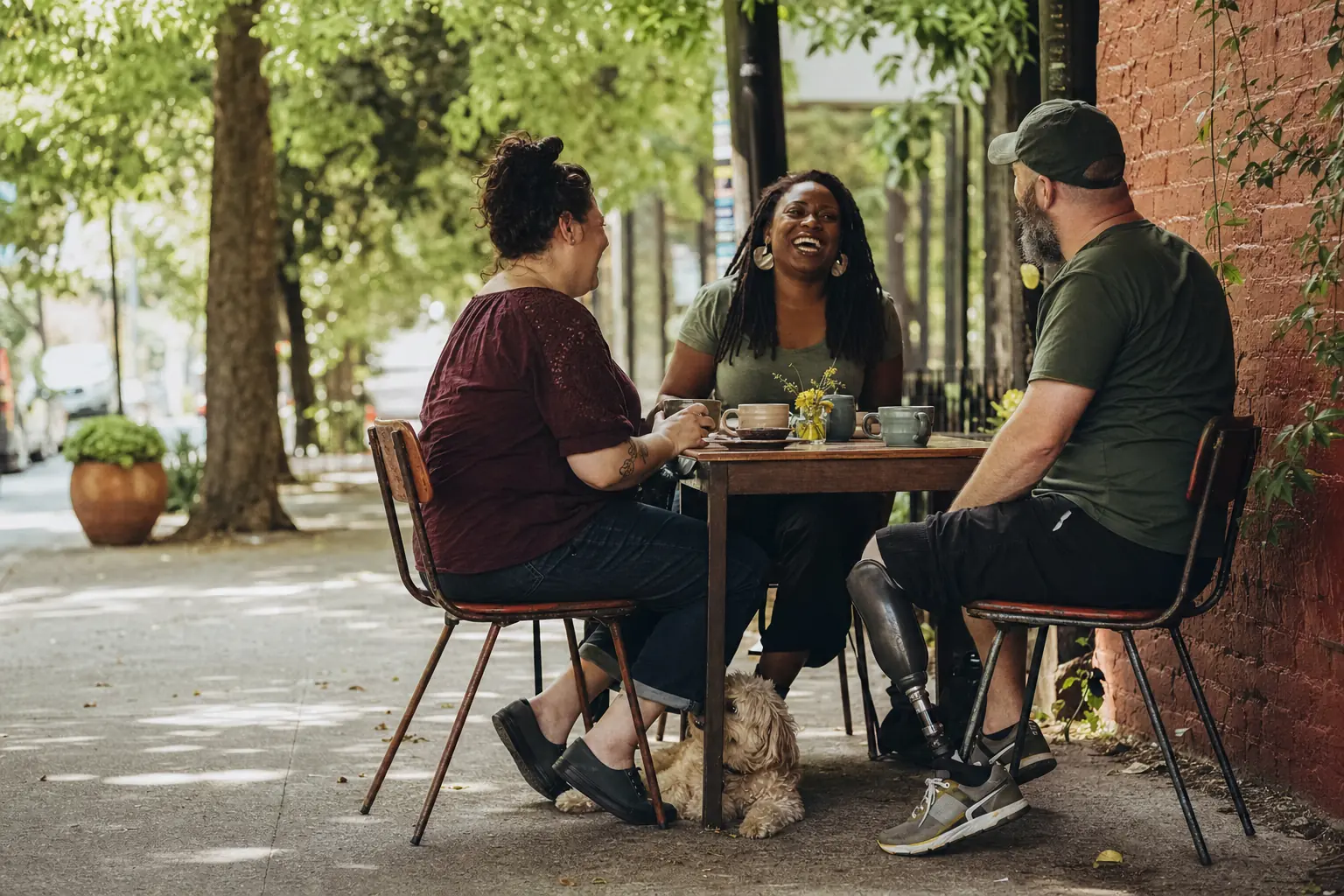
There is a difference between being surrounded by people and being understood. Peer support can offer the second one, but only if the room is right for you. And “peer support” covers a lot of rooms: a hospital volunteer who checks in before discharge, a Reddit thread at 2am, a WhatsApp group for adaptive cyclists, a formal support group run by a hospital social worker, a national conference. Some of them will be useful. Some will not. Knowing the shape of what you want makes it easier to find the thing that fits.
This is not a comprehensive directory. It is a map of the kinds of spaces that exist and how to approach them honestly.
Start with the shape of the ask
Before you look for a group or a connection, it helps to get specific about what you are looking for — because the answer determines where to look.
Practical information: What does it actually feel like to walk in these shoes? What did people wish they had known at discharge? What do they use for skin breakdown? Who is their prosthetist and why do they like them? This kind of peer knowledge is not in any clinical handout, and it is often the most useful thing someone further along can give you.
Shared experience without advice: Sometimes you want someone who gets it without wanting to fix you. The clinical world has a lot of problem-solving energy. So do many support groups. If you are not in a problem-solving phase, look for spaces that make room for that.
Age- or situation-specific connection: “Fellow amputee” is a broad category. A 28-year-old with a traumatic above-knee amputation and a 70-year-old with a dysvascular below-knee amputation may have very different day-to-day realities. Peer connection is most useful when the overlap is real. Pediatric and young-adult communities exist separately from general amputee networks.
Sport or activity focus: If you want to get back to running, swimming, climbing, or cycling, a sport-specific adaptive community will often connect you with people who have already solved the problems you are about to encounter. These groups tend to be more gear-forward and less grief-forward than general support groups, which may or may not be what you need right now.
Grief or emotional processing: This is a legitimate and specific need, and not every peer community is equipped for it. A social worker-led hospital group or a therapist who works with people adjusting to disability may be more useful here than a self-organized community forum.
A parent community: If you are the parent of a limb-different child, you may find more resonance in a parent-focused space than in the broader amputee community. The questions are different.
What exists nationally
Amputee Coalition (amputee-coalition.org)
The largest national nonprofit focused on limb loss and limb difference in the United States. Their National Limb Loss Resource Center offers information and support by phone, and their website has a support-group finder by zip code. They also run the Peer Visitor Program, a structured one-on-one connection program that trains amputees and limb-different people to support others at various stages of adjustment.
The Peer Visitor Program is specifically designed for hospital or early post-discharge connection. If you are recently post-op or are a family member of someone who is, this is worth requesting through your hospital social work team — many hospitals have an existing relationship with the program.
Amputee Coalition’s National Conference takes place annually and is one of the more useful in-person events if you want to meet a wide range of the community, see new devices, and connect with clinicians and researchers who work specifically in limb loss.
Veterans-specific support: Veterans who are amputees have overlapping but distinct needs. The VA’s Amputation System of Care has peer support components within some facilities. The Amputee Coalition also runs veterans-specific programs. Outside the VA, organizations like the Wounded Warrior Project, the Gary Sinise Foundation, and Team Red White & Blue offer different mixes of peer connection, activity programming, and direct support.
Amputee-specific online communities exist on most major platforms. Reddit’s r/amputee is a long-running, active community that skews practical and non-performatively supportive — basic questions get taken seriously, and the culture is generally anti-inspirational-porn. Facebook has numerous groups organized by amputation type, cause, age, and interest.
Local and clinical entry points
Hospital social workers and rehab teams often have direct connections to local support groups and can refer into the Amputee Coalition’s peer program. If you are still in inpatient or outpatient rehab, ask your social worker. They may know of a group that meets at the rehab facility, or they may have connections to the peer visitor network.
Your prosthetist’s clinic may organize informal patient events, especially larger practices. It is worth asking, even if it is not obvious from the outside. Practices that regularly serve amputees sometimes maintain informal networks of current and former patients who are willing to connect.
Local adaptive sport programs are frequently run by YMCAs, adaptive recreation nonprofits, and some hospital systems. They tend to be implicitly peer-supportive even when they are not explicitly framed that way. Showing up to try adaptive swimming or handcycling is a way to meet people without the pressure of a support-group format.
Evaluating a group or space
Give it more than one visit before you write it off — most groups have an off week — but do not stay past the point where you are clear it is not for you.
Signs a space is probably right:
- People can talk about difficulty without being redirected to gratitude or silver linings.
- Disagreement is possible without someone getting upset.
- You are not expected to share more than you want to.
- Basic questions are welcome, not treated as naive.
- The moderator or facilitators do not have a vested interest in how you feel about your experience.
Signs to move on from:
- The energy is primarily about performing resilience for an audience.
- Someone keeps steering you toward a product, provider, or program.
- You leave feeling like you did something wrong by not feeling better.
- The group has a fixed narrative about what recovery looks like.
One boundary that is always available to you
“Thanks, I am not looking for advice on that today” is a complete sentence in any of these settings. You do not have to explain or justify it. The right people — the kind worth staying for — will understand immediately.
A note for family members and supporters
Peer support exists for you too. The Amputee Coalition has resources for family and friends, and some of the limb-difference and parent communities are organized specifically around the experience of supporting someone else. If you are a caregiver or partner, a room full of other people in that role will understand your experience in a way the amputee community — however welcoming — cannot entirely replicate.
The guide on supporting someone after limb loss covers some of the practical side of this.
This guide is general information, not clinical or mental health advice. If you are having difficulty coping with limb loss or limb difference, a licensed mental health professional — particularly one who works with people adjusting to disability or chronic illness — can provide support that peer community is not designed to replace.