
Upper limb prosthetic control systems: what your options are and what to ask before choosing
Body-powered, surface EMG, pattern-recognition, and vision-assisted control systems all handle the same question differently: how does your device know what you want it to do? A practical guide to the four paradigms, the trade-offs, and the questions to bring to a clinical conversation.
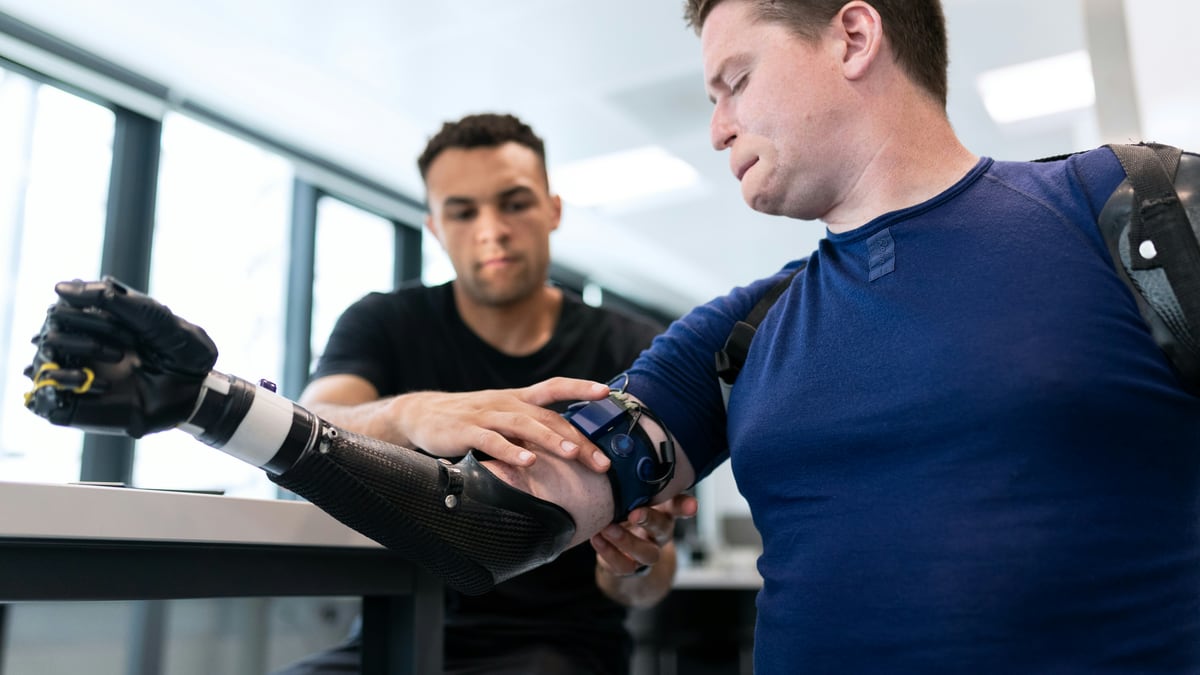
When your prosthetist asks what kind of control you want, they are asking what you want the signal between your intent and your device to be. The four current approaches use different signals and fail in different ways, and the practical differences matter more than most technology overviews acknowledge.
This guide covers the four paradigms: body-powered, surface EMG, pattern-recognition, and vision-assisted. It also covers hybrid setups, what shapes which options are actually available to you, and what questions to bring to a clinical conversation. It does not tell you what to choose. That depends on your residual limb, your muscle function, your daily context, and your insurance coverage, and it requires a clinical evaluation.
If you are earlier in the process and want a broader overview of device types, suspension, and daily life expectations, start with the upper limb prosthetics orientation guide.
Body-powered control
A cable runs from a harness across your shoulder or upper back to the terminal device. When you move your shoulder or scapula forward and down, the cable pulls and the device opens or closes in response to how much you move your body. You feel the resistance of what you are gripping through the cable.
The control signal is mechanical: your body position, transmitted directly. There is no processing delay, no battery, nothing to waterproof.
Body-powered systems are durable and suited to environments that would damage electronics. They give genuine proprioceptive feedback through cable tension, which helps with tasks that need grip control you can feel rather than see. They have been in clinical use for over a century and have been refined considerably over that time.
The limits: the harness can become uncomfortable over a long day and can cause pressure or friction issues. You need enough shoulder mobility and trunk strength to drive the cable. Grip force is limited by what you can produce through body movement. Switching grip configurations typically requires manually adjusting the terminal device.
Body-powered devices are not a fallback or older technology. For many users, they are the right primary device for specific tasks, even if they also use something else elsewhere.
Surface EMG (myoelectric) control
Muscles produce small electrical signals when they contract. EMG electrodes on the inside of the socket detect those signals from your residual limb skin. In a standard two-site setup, one electrode detects flexor signals and one detects extensor signals, and those drive the powered hand open or closed.
The control signal is electrical: your muscle activity, interpreted by electronics.
Multi-articulating hands use the same basic system but add grip pattern selection through co-contraction sequences, app control, or mode-switching via specific activation patterns. This lets one device move the wrist, switch between a pinch grip and a power grip, or adjust grip force based on the object.
Myoelectric systems have no cross-body harness. The motor provides grip force, so strength is not constrained by your body mechanics. Most terminal devices in this category look more like a hand than most body-powered options.
The trade-offs are real: a battery needs daily charging. Signal quality varies with socket fit and perspiration, so a loose socket or a hot day can degrade control. There is a small processing delay between intent and response. Insurance authorization for advanced hands typically requires documentation of functional need and often takes weeks.
Multi-mode systems have a real learning curve. Remembering the co-contraction sequence that triggers a specific grip pattern, under fatigue, in a busy environment, while your hands are full of something else, takes practice and attention that some people find manageable and some do not.
Pattern-recognition control
Standard myoelectric control assigns one electrode to open and one to close. Pattern-recognition control does something different: it reads the simultaneous electrical activity across multiple electrode sites and identifies the overall pattern of muscle activation, then maps that pattern to an intended movement.
The practical difference: instead of consciously contracting a specific muscle to trigger “close,” you attempt the movement you want to make as if your hand were present, and the system recognizes the full pattern. You are not managing a menu; you are attempting to move.
For users with higher-level amputations or more available muscle sites, this can allow more intuitive access to more grip configurations. Clinical reports from users who have trained on pattern-recognition systems describe it as less cognitively demanding for tasks that require frequent grip switching.
The caveats: pattern-recognition requires a calibration session (sometimes several) to train the system on your specific muscle patterns. If your limb volume changes significantly, calibration drifts and recalibration is needed. Socket fit matters more than in two-site systems, because poor contact disrupts the multi-site signal the whole classification depends on.
Not all clinics offer pattern-recognition systems and not all prosthetists have trained with them. This is a practical constraint before it is a clinical one.
Vision-assisted and AI-assisted grip
This is the newest category and the least commercially available. The idea: a camera identifies the object in front of you, software selects an appropriate grip configuration, and the hand is pre-positioned before you make contact. Your role is to complete the reach; the device handles the grip selection.
SmartARM, a Canadian startup, is developing a prototype that pairs Meta AI smart glasses with a prosthetic arm, using camera data and open-source AI models to select grips automatically. The O&P EDGE reported on the project in September 2026.
What this approach is trying to solve is a specific, documented problem: standard EMG control requires a conscious mode switch before each grip change. A vision system that anticipates the grip removes that cognitive step.
Where it sits: prototype stage, not commercially available as of late 2026. If a clinician or salesperson describes a vision-based grip system as ready to fit, ask specifically what the clinical evidence is and whether it has regulatory clearance. Understanding what this category is trying to solve helps you evaluate future claims about it.
Hybrid setups
Some users wear a body-powered frame with a myoelectric terminal device. Some use a myoelectric hand for most daily tasks and a body-powered hook for outdoor or wet work. Some use activity-specific terminal devices for particular sports, jobs, or hobbies that neither powered nor body-powered hands handle well.
This is not a compromise position. Multiple devices for different contexts is common and often the right answer. What your insurance will cover for a second or third device is a separate question from what the technology can do.
What shapes your actual options
Several factors determine what is genuinely available to you before you choose between paradigms.
Residual limb level. Transradial (below elbow) and transhumeral (above elbow) amputations present different constraints for each approach. Longer residual limbs generally offer more usable electrode sites for EMG-based systems. Transhumeral amputations require powered elbow components for myoelectric systems, which add cost and complexity.
Muscle function. EMG-based systems need detectable signals. Signal strength and consistency vary with residual limb anatomy, time since amputation, and whether procedures like targeted muscle reinnervation (TMR) have been done. A clinical evaluation will assess what you have to work with.
Work environment. If you work in water, chemicals, heat, or conditions that damage electronics, a body-powered primary device may be more practical regardless of what the technology can do. A powered device that fails at work is not available.
Insurance and K-level. Coverage for myoelectric hands typically requires a documented K-level determination and prior authorization. The prosthetic parity laws guide covers what state insurance laws require.
Rehabilitation access. Learning to use a myoelectric hand, and especially a pattern-recognition system, typically requires occupational therapy with someone experienced in upper limb prosthetics. In some areas, that expertise is hard to find. That is a real constraint worth naming before you commit to a system that depends on it.
Questions to bring to your prosthetist
You do not need to arrive having decided anything. These questions are for having a useful conversation rather than a vague one.
- What control approaches are viable given my residual limb and muscle function?
- What does each approach require day-to-day: charging, calibration, recalibration, maintenance?
- Which approaches can this practice fit, and which would require a referral?
- What will my insurance cover, and what documentation is needed for prior authorization?
- For [specific activity you care about], which approach handles that best?
- What rehabilitation will each approach require, and what is available locally?
- How does the learning curve compare across the options you are recommending?
The first appointment prep guide covers preparation in more detail.
This guide provides general information about upper limb prosthetic control technologies. It is not medical advice and is not a substitute for evaluation by a licensed prosthetist. Control system suitability depends on your residual limb anatomy, muscle function, lifestyle, and insurance coverage. A prosthetist evaluating your specific situation must guide your device selection.