
Lower limb prosthetics: a plain guide to device types, daily use, and what to expect
An orientation to prosthetic leg options: what amputation level determines, how foot, ankle, and knee systems differ, what the research shows about real-world use, and what to expect from fitting and insurance.
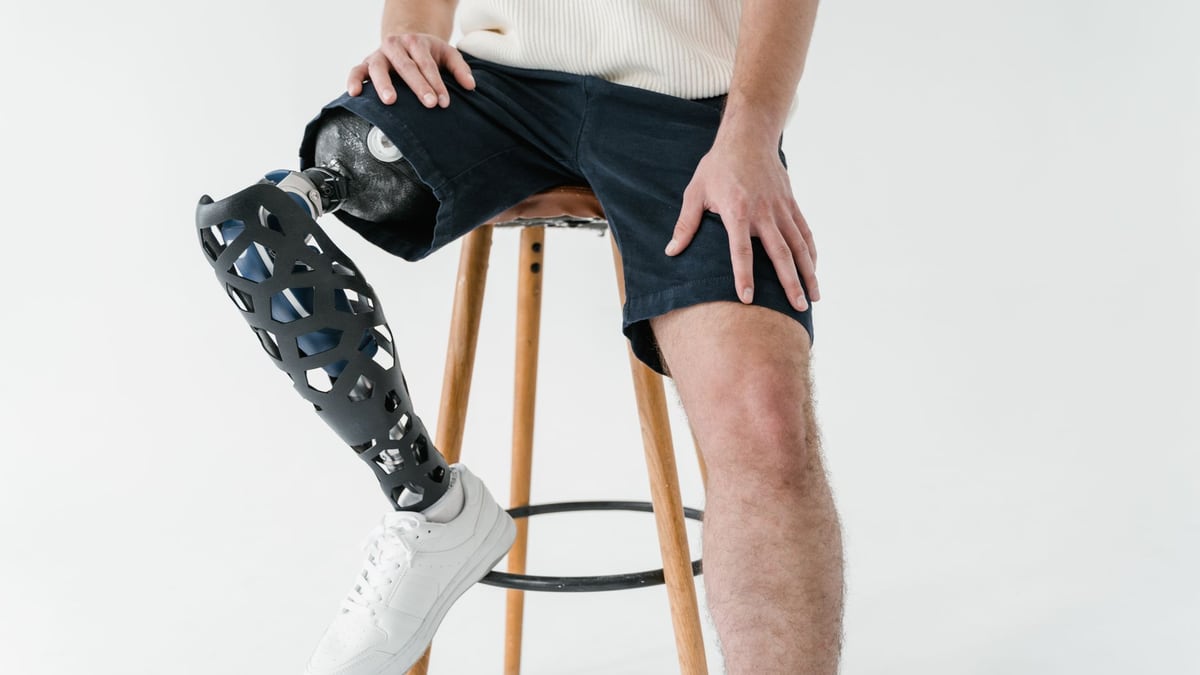
The territory of lower-limb prosthetics is wide, and most of what people first encounter about it is either clinical jargon that was not written for patients or marketing copy that was. This guide tries to be neither.
What follows is a practical map: what your amputation level determines, what the major component categories are and what they are actually designed for, how socket fitting works, what K-levels are and why they matter for coverage, and what real-world prosthetic use looks like when the clinical trials are over and it is just you and the grocery store. It does not tell you what to get. That is between you, your prosthetist, and the specifics of your body, your life, and your goals.
One thing to name upfront: lower-limb prosthetics are better than they were twenty years ago and considerably more varied. That is genuinely good. It also means there is more to sort through, more claims to evaluate, and more reason to know enough to ask useful questions.
Amputation level: the first variable
Before any conversation about device types, your amputation level sets the boundaries. The socket, the components, and the suspension system all follow from the anatomy.
Transtibial (below knee): The knee joint is intact. This is the most common lower-limb amputation level, and the one with the most developed commercial component market. Because the knee is present, a transtibial prosthesis addresses the ankle and foot only. The intact knee gives the user good mechanical leverage and control; the fitting challenge is the socket and suspension.
Transfemoral (above knee): The knee joint is absent. The prosthesis has to provide a knee function in addition to a foot and ankle. Transfemoral fitting is more complex than transtibial: the longer lever arm, the absence of the knee, and the proximity to the hip create different demands on socket design, suspension, and gait mechanics. Energy expenditure for walking is meaningfully higher than at the transtibial level, which affects component selection.
Knee disarticulation: The amputation is through the knee joint, with the distal femur preserved. The long residual limb provides good mechanical leverage and suspension options, but the knee unit must fit within the thigh profile, which limits component selection compared to a standard transfemoral fitting.
Transtibial with a very short residual limb: A short residual limb changes socket design significantly and may affect which suspension systems are practical. This is worth flagging with your prosthetist early.
Syme amputation: An ankle disarticulation that preserves the heel pad. The residual limb is long and end-bearing, which allows some limited walking without a prosthesis. Prosthetic options are narrow because of the bulbous distal end, but the functional outcomes for low-demand users can be good.
Partial foot: Partial foot amputations (removing toes, the forefoot, or up to the ankle) are the most variable category. Options range from simple toe filler inserts to custom carbon-fiber foot orthoses to prosthetic partial-foot systems. The functional impact and the prosthetic approach depend heavily on which structures remain.
Foot and ankle systems
For transtibial users and as a distal component for transfemoral systems, the foot-ankle assembly is the most frequently discussed component choice. The range is significant.
SACH foot (solid ankle cushion heel)
The SACH foot is the simplest and oldest design: a solid keel with a cushioned heel. No moving parts, no energy return, minimal maintenance. It is durable, inexpensive, and adequate for users with limited mobility needs, particularly for low-activity users, high-age users, or situations where reliability and simplicity are higher priorities than energy efficiency.
SACH feet are sometimes framed as a lesser option. They are not lesser for the population they serve. They are the right tool for a specific set of circumstances, which is what good component selection looks like.
Dynamic response feet (energy-storing and returning, ESR)
Dynamic response feet use a carbon-fiber keel that flexes under load and releases energy during push-off, mimicking, imperfectly but meaningfully, the spring function of a biological foot. They are the most common prosthetic foot for active transtibial users. The degree of stiffness, the geometry of the keel, and the height setting all affect gait. A foot that is too stiff for an individual’s weight and activity level does not flex enough to return energy; one that is too flexible does not provide stable push-off.
Most active-K3 and active-K4 users are fitted with some variant of a dynamic response foot. Within this category there is meaningful variation: low-profile feet, high-activity feet, running-specific blades, hydraulic or articulating ankle components, and what works for one person at a given activity level may not work for another.
Multiaxial and articulating ankle feet
A standard dynamic response foot has a fixed ankle. Multiaxial feet add movement in multiple planes (inversion, eversion, plantar flexion, dorsiflexion) which improves accommodation to uneven terrain. They are heavier than single-axis designs and have more moving parts. For users who navigate uneven surfaces frequently (outdoor environments, hiking, slopes, cobblestones), the tradeoff often makes sense. For users primarily on flat surfaces, the added weight and maintenance may not be worth it.
Some articulating ankle systems add a hydraulic element that adjusts ankle resistance based on gait speed. This is different from a microprocessor ankle in mechanism but addresses a similar functional goal: reducing the work required to adjust to changing walking speeds.
Microprocessor feet and ankles
A microprocessor ankle uses sensors to continuously adjust the ankle position and resistance in real time, responding to walking speed, terrain slope, and gait cadence. Published research on microprocessor ankles (Ottobock’s Taleo, Össur’s Proprio Foot and ESAR) shows improvements in metabolic efficiency, reduction in compensatory gait patterns, and patient-reported reductions in fatigue on uneven terrain and slopes compared to non-microprocessor systems.
What the research also shows, consistently, is that microprocessor ankle benefits are most pronounced for active users navigating varied terrain, specifically people walking at variable speeds and encountering frequent slope changes. The functional benefit for a user with a low activity level and a predictable walking environment is less clear and may not justify the cost, the maintenance, and the charging requirement. Battery life for microprocessor ankle components typically runs eight to sixteen hours under moderate use.
Medicare coverage for microprocessor ankles is limited. As of current policy, coverage for powered ankle-foot systems requires K4 functional classification, which is a relatively high activity bar. The Amputee Coalition’s resource library and your clinic’s billing team are the right places to verify current coverage policy for specific components.
Powered (bionic) ankles
Powered ankle systems (the most prominent is Össur’s Proprio Foot, though the powered category is separate from the passive-return ESR category) provide active plantarflexion via a motor during push-off. The clinical rationale is that they restore an energy input that passive systems can only partially approximate. Independent research on powered ankle systems shows reductions in metabolic energy expenditure compared to passive prostheses in some study populations; the effect size is real but varies considerably based on user activity level and terrain.
Coverage for powered prosthetic ankles under Medicare is constrained. The cost is high, the eligibility criteria are narrow, and denials are common. This does not mean they are not worth pursuing if the functional picture supports it; it means the documentation case needs to be solid.
Knee systems (transfemoral and knee disarticulation)
For users with above-knee amputations, the knee unit is the component with the most functional consequence.
Mechanical knees
A mechanical knee uses a physical locking or friction mechanism to control stance stability and swing-phase motion. Single-axis mechanical knees provide basic hinge function with manual or automatic locking for stance: the knee locks when weight is applied and unlocks for swing. Manual-locking knees keep the knee straight at all times unless the user explicitly unlocks it, which provides stability for low-activity users at the cost of a stiff gait.
Polycentric (four-bar linkage) mechanical knees provide greater inherent stability during stance because their geometry creates a moment arm that resists buckling under load. For moderate-activity users who do not have the functional profile for a microprocessor knee, polycentric designs can offer substantially better gait mechanics and safety than single-axis options.
Microprocessor knees
Microprocessor prosthetic knees (MPKs) use sensors and onboard processors to continuously monitor loading and adjust knee resistance in real time. The system identifies whether the user is standing, walking, descending stairs, navigating slopes, or stumbling, and adjusts the joint’s hydraulic or pneumatic resistance accordingly.
What the research shows about MPKs is worth knowing: multiple published trials and meta-analyses have found that MPK users show reduced incidence of falls compared to users of mechanical knees, improvements in walking speed and metabolic efficiency at variable speeds, and higher self-reported quality of life and confidence in mobility. The fall-reduction finding is among the most consistent in the literature. The fall consequences for a transfemoral amputee, particularly an older one, are serious, and the protective effect of MPK’s ability to adapt to stumbles and slope changes is clinically meaningful.
The functional benefit concentrates in certain populations: users who walk at variable speeds, navigate stairs and slopes, and have the physical capacity to walk in community environments. Users with K2 functional classification, who walk primarily on flat surfaces at slow, controlled speeds, are less likely to show benefit from MPK features, and Medicare’s coverage policy reflects this: MPKs are generally covered for K3 and K4 users meeting specific functional criteria, with prior authorization required.
MPKs require charging (typically overnight or every eight to sixteen hours), and the cost of the systems is substantially higher than mechanical knees. Like microprocessor ankles, they have maintenance requirements and failure modes that simpler mechanical systems do not.
Hydraulic and pneumatic swing-phase controls
Between a basic mechanical knee and a full MPK, hydraulic and pneumatic swing-phase control units provide responsive but non-computerized gait adaptation. These systems adjust knee resistance based on gait speed without requiring sensors or batteries. They are not as adaptive as MPKs but offer more natural gait mechanics than fixed-friction mechanical knees, with lower cost and no battery requirement. For active users who do not qualify for MPK coverage or who prefer simplicity, hydraulic units are worth knowing about.
Socket and liner basics
The socket is where the prosthesis meets the body, and it is where most prosthetic failures in daily use originate, not dramatic failures, but the slow accumulation of discomfort, skin issues, and fit instability that leads to a device spending time on a shelf.
Socket fit is highly individual. The residual limb shape, skin condition, bony prominences, soft tissue distribution, volume fluctuation patterns, and sweat patterns all influence how a socket is designed and what suspension system is appropriate. This means that socket fitting takes time, typically multiple visits over weeks, and that a socket that worked well initially may need revision as the residual limb matures and changes, particularly in the first one to two years post-amputation.
Volume fluctuation is the primary day-to-day management challenge. Residual limb volume changes throughout the day: it tends to shrink over the course of activity and expand after rest or in heat. A socket that fit in the morning may feel loose by mid-afternoon. Prosthetic sock ply management, adding or removing socks of different thicknesses to compensate for volume change, is the traditional and still-common approach to this. The sock ply management guide covers this in practical detail. Some users use elevated vacuum suspension systems that maintain fit more consistently through volume changes; others use volume management stockings.
Liners, usually silicone, urethane, or thermoplastic elastomer, are worn directly over the residual limb as the interface between skin and socket. They protect skin, distribute pressure, and provide the suspension mechanism in pin/lock and suction systems. Liner material affects how the skin breathes, how sweat is managed, and how the liner responds to heat. Liner hygiene matters: a liner that is not cleaned properly accumulates skin oils and degradation products that affect adhesion and increase skin irritation risk. The residual limb skin care guide covers liner care in detail.
Suspension, how the prosthesis stays on, follows from the socket design and liner. The main options:
- Pin/lock: A pin at the bottom of the liner locks into a ratchet mechanism in the socket. Reliable and simple, but fit depends on liner stretch and residual limb volume; if volume drops significantly, the pin engages before the socket is fully seated.
- Suction: A valve expels air when donning; the socket seals to the residual limb. Volume-sensitive: a significant volume drop breaks the seal.
- Elevated vacuum: An active pump maintains suction continuously, compensating for volume fluctuation throughout the day. More consistent fit across the day; adds a battery and mechanical complexity.
- Locking liner: Liners with a textured or adhesive surface that grip the socket wall directly without a pin. Used in some elevated vacuum and suspension sleeve systems.
- Suspension sleeve: A neoprene or urethane sleeve extends from above the socket edge over the thigh to add suspension. Simple, adds a layer of security, can be used with other systems. Gets hot.
No suspension system is universally better. Choice depends on residual limb shape, activity level, sweat patterns, and what your prosthetist’s assessment shows about your specific fitting situation.
K-levels and functional classification
K-levels are the Medicare system’s way of classifying prosthetic users by predicted functional capacity. They matter because they determine coverage.
- K0: Not a prosthetic candidate. No functional ambulation potential.
- K1: Household ambulator. Walks at home on level surfaces at a fixed cadence.
- K2: Limited community ambulator. Can walk on low-level environmental barriers: curbs, some uneven surfaces.
- K3: Community ambulator. Walks at variable speed, can navigate most community environments. The K3/K4 boundary is where many component debates concentrate.
- K4: High activity: sports, physical labor, high stress on the prosthesis. Includes active adults, children, and athletes.
K-levels are assigned by the prescribing physician and documented in the medical record; they must be supported by clinical findings, not just stated. The classification determines which HCPCS codes Medicare will pay for, which is why the functional documentation in your record matters, not just for initial fitting but for appeals if coverage is denied.
The K-levels guide covers what each level requires and how a reassessment works if your functional status changes or if you believe you were classified incorrectly.
What insurance typically covers, and what it doesn’t
Medicare: Medicare covers lower-limb prostheses under DMEPOS using L-codes, subject to medical necessity criteria set by Local Coverage Determination L33944. Coverage depends on K-level, diagnosis, and the specific component’s classification. The general pattern:
- K1 users are covered for basic SACH feet and standard sockets.
- K2 users are covered for dynamic response feet and improved suspension systems.
- K3 and K4 users have access to a broader component range including more sophisticated foot systems and, for K3/K4 transfemoral users, microprocessor knees under specific criteria.
- Microprocessor ankles have narrow coverage criteria, generally K4.
- Activity-specific components (running prostheses, sport-specific devices) face significant coverage barriers and are frequently denied.
Prior authorization now applies to a broader set of L-codes than it did several years ago. That means your supplier must submit documentation to the Medicare Administrative Contractor and receive approval before delivering the device. Prior authorization does not guarantee payment; it is a preliminary determination that, if the claim matches the approved request, coverage should apply. It also adds time. The CMS prior authorization guide covers the three documentation requirements and what to expect from each.
If a claim is denied, the appeals process is available. The Medicare appeals guide walks through the five levels.
Medicaid: Medicaid prosthetics coverage varies by state. Some states cover a comparable range to Medicare; others have narrower coverage, lower reimbursement rates, and fewer enrolled providers. The Medicaid prosthetics guide covers the state-by-state variation.
Private insurance: Commercial and marketplace plans vary significantly in prosthetic coverage: what components they cover, whether prior authorization is required, and whether they cap annual or lifetime benefits. Some states have enacted prosthetic parity laws requiring commercial plans to cover prosthetics comparably to other medical devices. The specifics of your plan document govern; your clinic’s billing staff can often identify the relevant sections faster than you can.
VA: Veterans Affairs provides prosthetic coverage for qualifying veterans through a separate system. VA prosthetic care is generally comprehensive and covers components that Medicare might not, but access depends on enrollment status and service connection. The VA prosthetics guide covers dual VA-Medicare situations.
What daily use actually looks like
Prosthetic research tends to report means and group averages. Real use is more variable, and the gap between clinical trial conditions and daily life is consistent and worth naming.
Published data on lower-limb prosthetics report outcomes like: activity levels as measured by step counts or accelerometry, community ambulation distance, metabolic cost compared to a non-amputee population, quality-of-life scores, and fall rates. These are real and useful measures. They do not tell you that a K3 community ambulator using a dynamic response foot will still have days when the socket doesn’t fit well, when fatigue hits differently, or when a specific terrain problem catches them off guard. That is not a failure of the research; it is just what daily life with a prosthesis is.
Some things that clinical trials do capture, and that are worth knowing:
Residual limb changes are long-term. Limb volume changes most rapidly in the first year after amputation but continues to shift over time with weight change, activity level changes, and aging. A socket that fits well at year one may need revision at year three. This is expected, not a sign that something went wrong.
Skin problems are common. A survey published in the Journal of Rehabilitation Research and Development found that more than 70% of prosthetic users reported skin problems at the residual limb interface, and that skin problems were among the leading causes of prosthesis non-use. Liner hygiene, socket fit, sweat management, and regular skin checks are practical, not optional.
Most component improvements show meaningful but not transformative effects. The microprocessor knee data is the strongest evidence of a clinically significant component effect, particularly the fall-reduction finding. For other component comparisons, effect sizes are often modest in group averages, which means the component decision is less determinative than the overall quality of fitting, alignment, and rehabilitation.
Rejection and non-use are real. Non-use rates in the literature for lower-limb prostheses are lower than for upper-limb, but they are not zero. The most common reasons documented are fit problems, pain, excessive weight, and insufficient rehabilitation support. A prosthesis that does not fit well and that the user was not taught to use effectively does not get used. These are system failures, not personal ones.
Questions to bring to your prosthetist consult
These are not exhaustive, since your situation has specifics that matter, but they are places to start:
- Based on my amputation level, diagnosis, and functional goals, what K-level do you anticipate documenting for my fitting, and what components does that level support?
- What foot/ankle system are you recommending and why: what is it designed to do that alternatives are not?
- If I am transfemoral: what knee unit are you recommending, and what does the research show about outcomes for users with my functional profile?
- What suspension system are you recommending, and what are the alternatives?
- How do you handle volume fluctuation? What sock management system would you expect me to need?
- What is the expected timeline from fitting to a functional prosthesis, and how many fitting appointments should I expect?
- What is my role in the fitting process: what feedback do I need to give you, and what changes can I make between appointments versus what requires an appointment?
- What does a socket that needs revision look like, and how do I tell the difference between normal adjustment and something that needs your attention? (The socket fit problems guide covers the warning signs in detail.)
- What is the billing pathway for this fitting: what codes are being submitted, does it require prior authorization, and is any part of it likely to generate a patient cost I should plan for?
Amputee News does not provide individualized medical, fitting, or insurance advice. Lower-limb prosthetic prescriptions depend on your specific diagnosis, functional assessment, medical history, and payer coverage. This guide is for orientation and does not substitute for a clinical evaluation by a qualified prosthetist and prescribing practitioner. For questions about your coverage, contact your payer directly or consult a State Health Insurance Assistance Program (SHIP) counselor at no cost.
Source notebook: This guide draws on Amputee Coalition: Limb Loss Resource Center, patient education library for people with limb loss and limb difference ↗. We link out so you can follow the receipts.