
The first months of prosthetic use: wearing schedules, gait training, and what to expect as daily wear builds
A practical orientation to the early months of living with a lower limb prosthesis: how wearing time builds, what gait training is actually teaching you, how limb volume affects everything in this period, and how to know when to call versus when to wait.
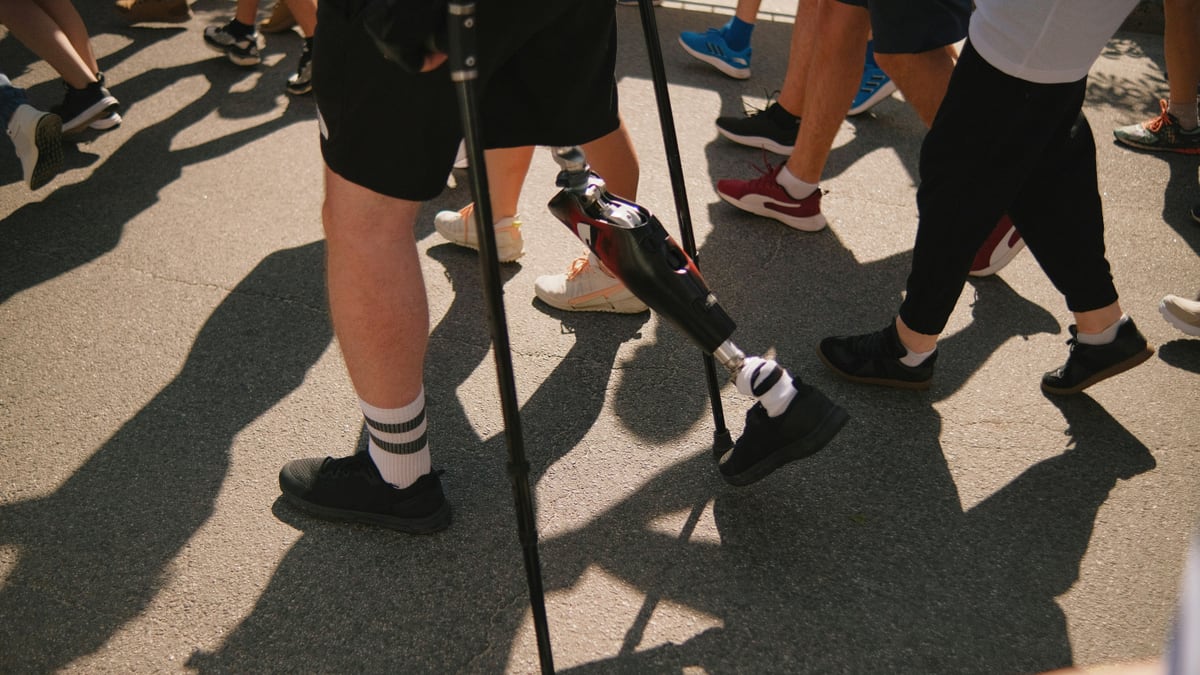
Getting a prosthesis fitted is not the same as using a prosthesis. The fitting is an hour or two in a clinic. What follows is weeks of learning to wear it, then weeks of learning to move in it, then months of learning to trust it enough to stop thinking about it. This guide is about that middle stretch, from first fitting to something approaching ordinary daily life, because that is the part almost nobody prepares you for.
Nothing here replaces your prosthetist or your physical therapist. They know the specifics of your body, your device, and your situation. This is context for conversations with them, not an alternative to having those conversations.
The wearing schedule exists for a reason
Most people expect to put on a prosthesis for the first time and immediately use it. The first appointment is often surprising: you may wear it for an hour, two at most, and then stop. That is correct.
Residual limb tissue is not used to sustained pressure against a rigid socket. The skin, fascia, and underlying structure have to adapt, and they adapt better to graduated exposure than to being forced through it. Wearing too long too fast causes skin breakdown, pressure sores, and swelling that can set your timeline back more than cautious progression ever would.
A typical progression for a new user with a transtibial (below-knee) prosthesis might look like: two to three hours per session for the first week, with periods of skin inspection in between, then gradually extending session length as your skin tolerates it. The progression for transfemoral (above-knee) users is similar but often slower because the socket covers more tissue and the fit demands are higher.
Your prosthetist will give you a specific schedule based on your situation. Follow it. If you are itching to do more, that energy is better used on exercises between wearing sessions than on wearing longer before your skin is ready.
Skin checks between sessions: Take the prosthesis off after wearing and look at the residual limb. Redness that fades within 20 minutes is normal pressure response. Redness that stays beyond that, blisters, open areas, or broken skin: stop wearing and call your prosthetist before putting the device back on.
What gait training is actually teaching you
Walking with a prosthesis is not walking. The mechanics are genuinely different: the prosthetic foot and ankle do not function like biological ones, weight distribution through the residual limb and socket is different from what your nervous system expects, and the muscles doing the work are not the ones they were before.
Physical therapy in this phase has a few goals running simultaneously.
Weight shift. A lot of new users unconsciously favor their intact limb, loading it more than the prosthetic side. This is intuitive but creates an asymmetric gait that becomes a habit fast and is hard to unlearn. Your PT will use mirrors, parallel bars, and feedback cues to get you to shift weight properly over the prosthesis during each step.
Cadence and step length. Even when weight shift is managed, new users often take shorter steps on the prosthetic side than the intact side. Symmetric step length takes deliberate practice.
Hip extension. For transtibial users in particular, adequate hip extension during push-off is what loads the energy-return elements of a dynamic response foot correctly. Without it, you get energy absorption without return, which is exhausting.
Stairs, slopes, and uneven ground. Flat-surface walking is the baseline. Real environments are not flat. Your PT will progress you through these progressively because they each require different adaptations.
Falls and recovery. Learning how to fall safely and how to get up from the floor with a prosthesis is part of gait training, not an afterthought. If your PT is not covering this, ask.
The unfamiliar movements your brain is learning in this period take longer to consolidate than they might feel like they should. What is choppy and effortful in week two is often smoother in week six, not because the prosthesis changed but because the motor patterns became more automatic. Be patient with the timeline even when it is frustrating.
Fatigue in the first months is real and has a physical cause
New prosthesis users are often caught off guard by how tired they are. Walking with a lower limb prosthesis costs significantly more metabolic energy than walking without one: the exact amount depends on amputation level and individual factors, but the increase is real and well-documented. Add to that the fact that you are learning a new movement pattern, which requires conscious cognitive effort in a way that habitual walking does not, and the fatigue is not surprising. It is physiological.
This changes. As gait becomes more automatic and as your cardiovascular conditioning builds, the fatigue decreases. But in the first months, building rest into your schedule is not laziness. It is part of the process.
If you are finding yourself unable to do PT sessions at the intensity your therapist expects, mention it. Fatigue management is part of rehabilitation planning.
Limb volume in the first months: this is the period when it matters most
In the months after amputation, residual limb volume changes faster than at almost any other time. The post-surgical swelling resolves. Soft tissue remodels. Body weight may shift. All of this affects how the socket fits.
This is why many prosthetists fit a preparatory or temporary socket before a definitive device: a socket fitted to the limb in month two may not fit the limb in month six. As volume stabilizes, the fit usually needs to be revisited.
Between appointments, prosthetic socks are the main tool for managing volume. A limb that has lost volume since the socket was made will feel loose in the socket: the device may piston (move up and down with each step), the suspension may feel unreliable, or the heel may feel inconsistent. Adding socks adds volume between the limb and the socket to compensate.
The number of plies you are adding or removing in a day is useful information for your prosthetist. If you are consistently adding three or more plies and the socket still feels loose, or if no amount of adjustment gets it comfortable, that is a clinical conversation, not something to manage around. See the guide on managing prosthetic sock ply and the guide on socket fit problems for more on what to do.
Home practice between PT sessions
Your PT sees you a few times a week. The rest of the time is yours. What you do between sessions matters.
Wear the prosthesis during the activities your PT says are appropriate. If you are cleared to do household tasks with the prosthesis on, doing them builds the functional skills you are working on in PT.
Practice what is hard, not what is easy. The temptation is to do more of the movement patterns that already feel comfortable. But the uneven terrain, the steps, the slow turns: those are where skill builds.
Residual limb care. Keep the liner and socket clean. Inspect your residual limb daily. Skin problems that are caught early are minor. Skin problems that are caught late are not. The guide on residual limb skin care and socket hygiene covers the daily routine in detail.
Strengthen the rest of the system. Core strength, hip strength, and intact-limb conditioning all affect how well the prosthesis works. Exercises prescribed by your PT are not optional add-ons.
When to call your prosthetist vs. when to wait
The hesitation to call the clinic is common and often counterproductive. Here is a rough guide:
Call the prosthetist if:
- The socket does not feel right after sock adjustment, and it is affecting your gait or causing discomfort
- You have skin breakdown, blisters, or open areas
- The suspension feels unreliable (excessive pistoning, device coming off unexpectedly)
- A component seems to be damaged or is making a new sound
- Your limb has changed enough that you are consistently maxing out socks and still feeling loose
Call your PT if:
- A movement or skill from therapy is not making sense and you are not sure you are doing it correctly
- You are experiencing pain or difficulty with a specific activity that therapy has not addressed
- Your fatigue is making it hard to complete sessions
Wait and monitor if:
- Minor redness after wearing that fades within 20 minutes
- Day-to-day variation in how the socket fits that is manageable with one or two plies of socks
- Muscle soreness in new areas from using unfamiliar movement patterns
What progress looks like around the 90-day mark
There is no universal 90-day standard. Some people are walking independently on varied terrain at six weeks. Others are still working toward it at five months, because of amputation level, health factors, or the complexity of the device. Both can be appropriate trajectories.
What usually improves across the first three months for most lower-limb prosthesis users: wearing tolerance increases substantially, gait becomes more automatic and less effortful, energy expenditure for basic tasks decreases, and the device starts feeling like part of you rather than a thing attached to you.
What often does not resolve on its own: fit problems, skin problems, and pain. Those need clinical attention.
At the three-month mark, many prosthetists move toward a more definitive device as limb volume stabilizes. This is a good time to revisit your functional goals with both your prosthetist and your PT: what are you working toward next, and what component choices or training priorities support that?
The early months are the steepest part of the learning curve. Most people who get through them find the other side is more functional than the beginning suggested.
About this guide: This is orientation information for adults adjusting to lower limb prosthetic use, based on typical rehabilitation pathways. Individual timelines, device characteristics, and clinical factors vary significantly. Use this as background for conversations with your prosthetist and physical therapist, not as a prediction or prescription for your specific situation.
Related guides: After amputation: the clinical pathway to your first prosthesis | What to ask at your first prosthetist appointment | Managing prosthetic sock ply | Socket fit problems: when to wait and when to call | Residual limb pain
Source notebook: This guide draws on Amputee Coalition: Limb Loss Resource Center, patient education library for people with limb loss and limb difference ↗. We link out so you can follow the receipts.