
A clinical trial compared two quasi-passive prosthetic ankles against standard ESR devices. The results were not evenly distributed.
A randomized crossover trial including Hugh Herr compared variable-stiffness and variable-damping quasi-passive ankles against two ESR ankles across eight walking tasks. What the study found, what it didn't, and what quasi-passive actually means for transtibial amputees.
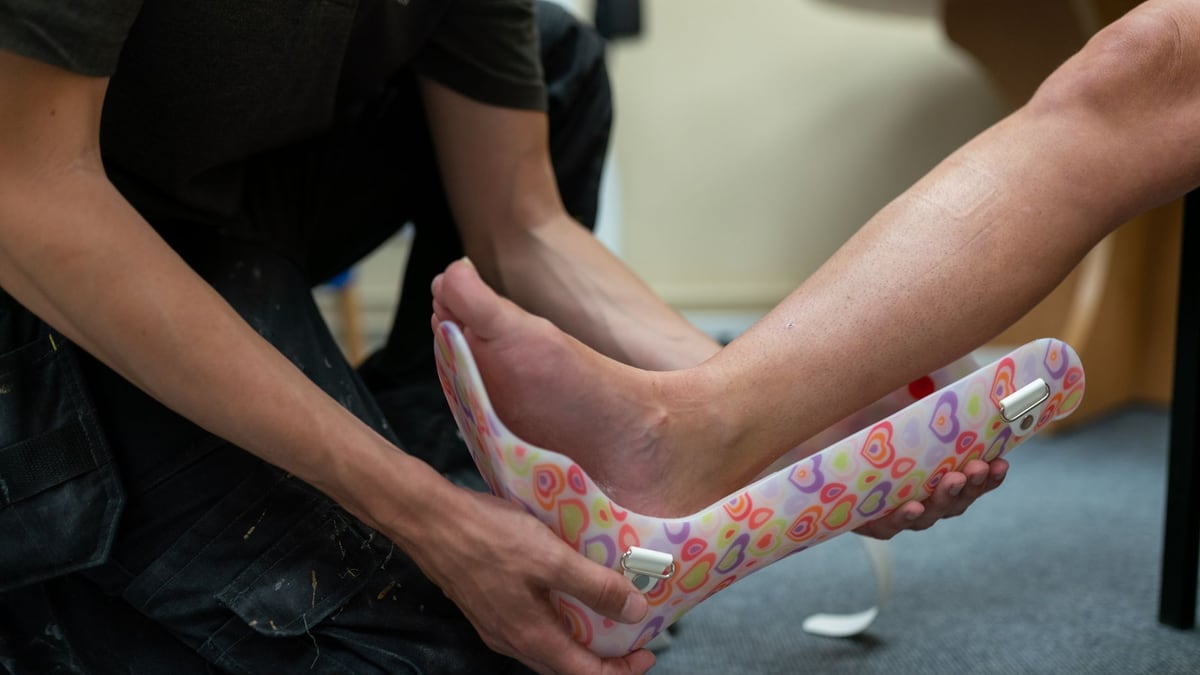
The O&P EDGE this week covered a study comparing two quasi-passive prosthetic ankle designs against energy storage and return (ESR) ankles across a range of walking tasks. The headline result: one of the quasi-passive designs performed comparably to ESR on flat ground and better than ESR on a downward slope, while the other quasi-passive design was the least preferred device in the trial.
The study, published open-access in Scientific Reports under the title “A comparison of passive and quasi-passive prosthetic ankles over varying speeds and terrains,” enrolled seven adults with unilateral transtibial amputations. The research team included Hugh Herr, PhD, whose group has been active in powered and quasi-powered lower limb devices.
What quasi-passive means
“Passive” in prosthetics means a device with no motor, no battery, and no active control. ESR ankles are the category most transtibial amputees know: a carbon-fiber or composite structure that compresses during stance phase, stores elastic energy, and returns it at toe-off to assist push-off. They work well at the specific stiffness they were tuned for. They don’t adjust.
Quasi-passive devices sit between passive and fully powered. They change their mechanical behavior in response to load or position, using passive mechanisms rather than a motor. A variable-stiffness ankle changes how stiff it is. A variable-damping ankle changes how much it resists movement. Neither requires external power. Both can, in principle, adapt to conditions that a fixed-stiffness ESR device handles less well.
The appeal is practical: fully powered ankle prosthetics exist, but they add weight, require charging, and cost more than passive devices. A quasi-passive device that captures some of the adaptability without those trade-offs would be clinically useful.
What the trial found
Seven participants each tested all four devices across eight tasks: three level-ground walking speeds, a figure-eight course, a 5-degree incline, a 5-degree decline, stairs up, and stairs down. Five of the tasks were instrumented with motion capture and force plates. Participants also gave feedback ratings for each device after each task.
Variable damping was the least preferred device across tasks, by both participant feedback scores and biomechanical metrics. The O&P EDGE summary did not characterize the gap as close.
On level ground, the variable-stiffness ankle and the two ESR ankles drew similar participant ratings. The instrumented data added a complication: at faster walking speeds, the ESR ankles produced higher peak power and more center-of-mass push-off work. Variable stiffness matched them at slow and moderate speeds; the gap opened at the faster end.
On decline walking, participants preferred the variable-stiffness ankle over both ESR devices. Notably, the measured biomechanical metrics did not show a statistically significant difference, which means the subjective preference diverged from what the force plates captured. The study notes the discrepancy; it does not resolve it.
What the study doesn’t cover
Seven participants is a small sample. The study used a crossover design, meaning every participant tested every device rather than being randomized to a single one, which is a reasonable approach when the population has high individual variability. But seven people cannot support strong generalizations about who benefits most, or whether outcomes differ by time since amputation, activity level, residual limb length, or socket fit.
The tasks were controlled lab conditions. A 5-degree slope is modest. Stairs and figure-eights are useful controlled tests, not the full range of terrain a working-age ambulatory amputee encounters. Long-term wear, device reliability, and fit maintenance are not addressed.
The study does not include cost data for the prototype devices tested.
What this means
The variable-stiffness finding on decline walking is the result worth tracking. The mechanics of why an adaptive-stiffness ankle might perform better going downhill make sense: the loading patterns during controlled descent differ from those during level-ground push-off, and a device that can shift its stiffness to match may feel more stable to the wearer. The study adds a trial result to what had been a primarily theoretical argument.
The variable-damping result is less straightforward. It may reflect that resistance to movement is a less useful adaptation for the tasks tested. It may also reflect something specific to the prototype’s implementation. The study tested one damping profile; it did not test whether different settings would produce a different ranking.
For people with transtibial amputations: this is early-stage research with a small sample. The devices compared are research-grade prototypes, not currently available for clinical prescription. The open-access paper in Scientific Reports includes a detailed methods section if you want the specifics on task protocol and measurement approach; the source link is below.
This article covers research findings and is not a recommendation for any specific prosthetic device. Prosthetic selection involves individual clinical assessment. Talk to your prosthetist and prescribing clinician about options suited to your functional goals and anatomy.
Source notebook: This reporting draws on The O&P EDGE: Quasi-Passive Prosthetic Ankles Have Functional Benefits, September 2026 ↗. We link out so you can follow the receipts.