
Osseointegration: what a bone-anchored prosthesis is, who qualifies, and what the evidence shows
O&P EDGE profiled Tre Adkins's experience with osseointegration. Here's the broader picture: how the procedure works, what the research says about outcomes and risks, and the questions worth bringing to a surgical team.
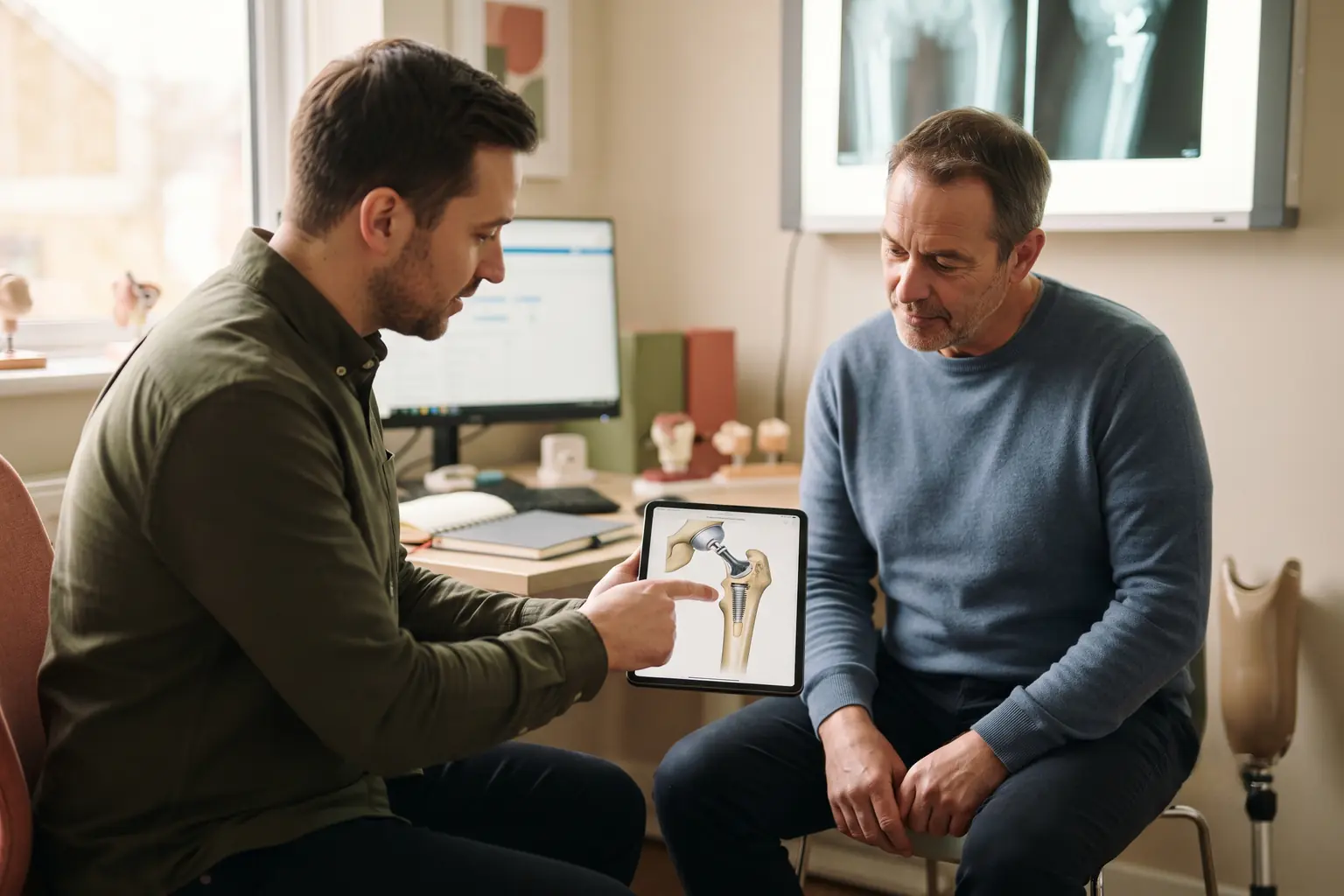
The O&P EDGE this week profiled Tre Adkins, a lower-limb amputee whose prosthetic care included osseointegration. The profile conveys one person’s experience with the procedure. The technology itself, bone-anchored prosthetic attachment, has been moving from a niche surgical option to a more available one over the past decade, and it generates enough questions in clinical conversations to warrant a direct explanation.
What osseointegration is
A conventional prosthesis connects to the residual limb through a socket: a fitted interface the limb sits inside, held in place by suction, locking mechanisms, or suspension sleeves. That system works well for many people. For others, the socket is the chronic problem: skin breakdown, poor fit as body weight or muscle mass changes, restricted mobility at the hip, or the accumulated discomfort of an interface the residual limb has never fully tolerated.
Osseointegration takes a different approach. A titanium implant is surgically placed into the bone of the residual limb. Over months, the bone grows into the implant, a process called osseointegration, the same mechanism used in dental implants and some joint replacements. Once that bond has formed, a percutaneous abutment protrudes through the skin, and the prosthetic limb attaches directly to that abutment rather than to a socket.
The result is a direct skeletal connection between the prosthesis and the body.
What changes, and what does not
The practical differences most often cited by researchers and by people who have had the procedure:
No socket interface. Because there is no socket, there is no residual-limb contact surface to cause chafing, pressure sores, or the hygiene challenges of a suspension sleeve. For people who have spent years managing socket-related skin problems, that change is significant.
Osseoperception. When the prosthesis connects to bone, vibration and ground-contact feedback transmit through the skeletal system differently than through a socket. Some users report improved sensory awareness of terrain and surface changes. The research on this phenomenon is real but still being characterized: it does not produce precise tactile sensation, and the effect varies between individuals.
Range of motion. For transfemoral (above-knee) amputees in particular, removing the socket often improves hip flexion and sitting comfort, because there is no rigid interface compressing the proximal thigh.
What does not change: osseointegration does not modify the prosthetic components themselves. Knee units, microprocessor systems, foot-ankle assemblies: those choices are made separately and depend on the same clinical criteria as before. The implant changes how the prosthesis attaches; it does not upgrade what the prosthesis does.
Who qualifies
The candidate criteria matter because osseointegration is not applicable to everyone, and the surgical and rehabilitation demands are substantial.
Factors that surgical teams have used in candidacy assessment include:
- Adequate residual bone stock and density to anchor and sustain the implant over time
- No active infection at or near the surgical site
- Controlled or absent diabetes (uncontrolled diabetes impairs bone healing and significantly raises infection risk)
- Non-smoking status, or demonstrated willingness to stop; smoking impairs osseointegration
- Sufficient overall health to undergo surgery and a structured, months-long rehabilitation period
- In most published protocols, a minimum interval since amputation, to allow residual-limb maturation
Younger adults with transfemoral amputation who have chronic socket-related problems have historically been the population most studied. Procedures for transradial (below-elbow) and transtibial (below-knee) amputation exist and are being investigated, but the evidence base is smaller and the indications are narrower.
The procedure and timeline
Osseointegration in lower-limb amputation is typically staged. The implant is placed in a first surgery. The abutment, the component that protrudes through the skin, is introduced in a second procedure, after an initial osseointegration period. The full timeline from first surgery to walking on the integrated prosthesis is typically measured in months, not weeks. Rehabilitation is structured and intensive throughout.
The percutaneous site, where the abutment exits the skin, requires ongoing hygiene maintenance indefinitely. It is a permanent open pathway between the external environment and the internal implant. Infection management at that site is a continuing clinical responsibility, not a post-operative concern that ends at discharge.
What the evidence says
Research on osseointegration for lower-limb amputation has been building for roughly three decades, with foundational work in Sweden and Australia. The available evidence, including randomized controlled trials and longer-term follow-up studies, generally shows improved mobility and quality-of-life outcomes for selected candidates compared to socket prostheses in the same population.
The risk picture includes periprosthetic fracture (fracture of the bone at or near the implant under mechanical load), implant-site infection, and implant failure requiring revision surgery. These are not common in well-selected patients managed by experienced surgical teams, but they are real risks with real clinical significance. Rates reported in the literature vary by study design, follow-up length, and how failure is defined.
In the United States, the OPRA Implant System received FDA clearance for transfemoral osseointegration. Other systems are in clinical use internationally. Access in the US depends heavily on proximity to surgical teams with sufficient training and volume, which concentrates practical options geographically.
What this means for a clinical conversation
If socket fit has been a chronic problem (years of skin breakdown, recurrent revisions, significant limits on what the prosthesis allows), osseointegration is a question worth raising with a prosthetist or physiatrist. Not as an assumed solution, but as a documented option with a specific candidacy profile and a specific clinical pathway.
The questions that tend to produce useful information:
- Based on my residual limb, bone density, and health history, am I a realistic candidate?
- What surgical teams in my region have volume and published outcomes in this procedure?
- What does the full timeline look like, including the staged surgeries, rehabilitation, and return to work?
- What does lifelong abutment-site management involve, and who handles that care?
- What happens if the implant fails or requires revision?
The Adkins profile at O&P EDGE describes one person’s trajectory. A clinical evidence base describes a population of carefully selected candidates. The distance between those two things is where the conversation for any individual actually happens, with a team that knows the specifics of that person’s anatomy, history, and goals.
Amputee News does not provide individualized medical, surgical, or device-fitting advice. Osseointegration candidacy depends on factors specific to each person’s anatomy, health, and clinical history. Discuss surgical and prosthetic options with your care team.
Source notebook: This reporting draws on O&P EDGE's profile of Tre Adkins and his osseointegration experience ↗. We link out so you can follow the receipts.