
Plaster to pixels: fifteen years of digital fabrication in O&P, and what the shift actually means for patients
A clinician's 15-year reflection in The O&P EDGE traces how 3D printing and digital scanning changed prosthetic fabrication. The patient-side version of that story is more complicated.
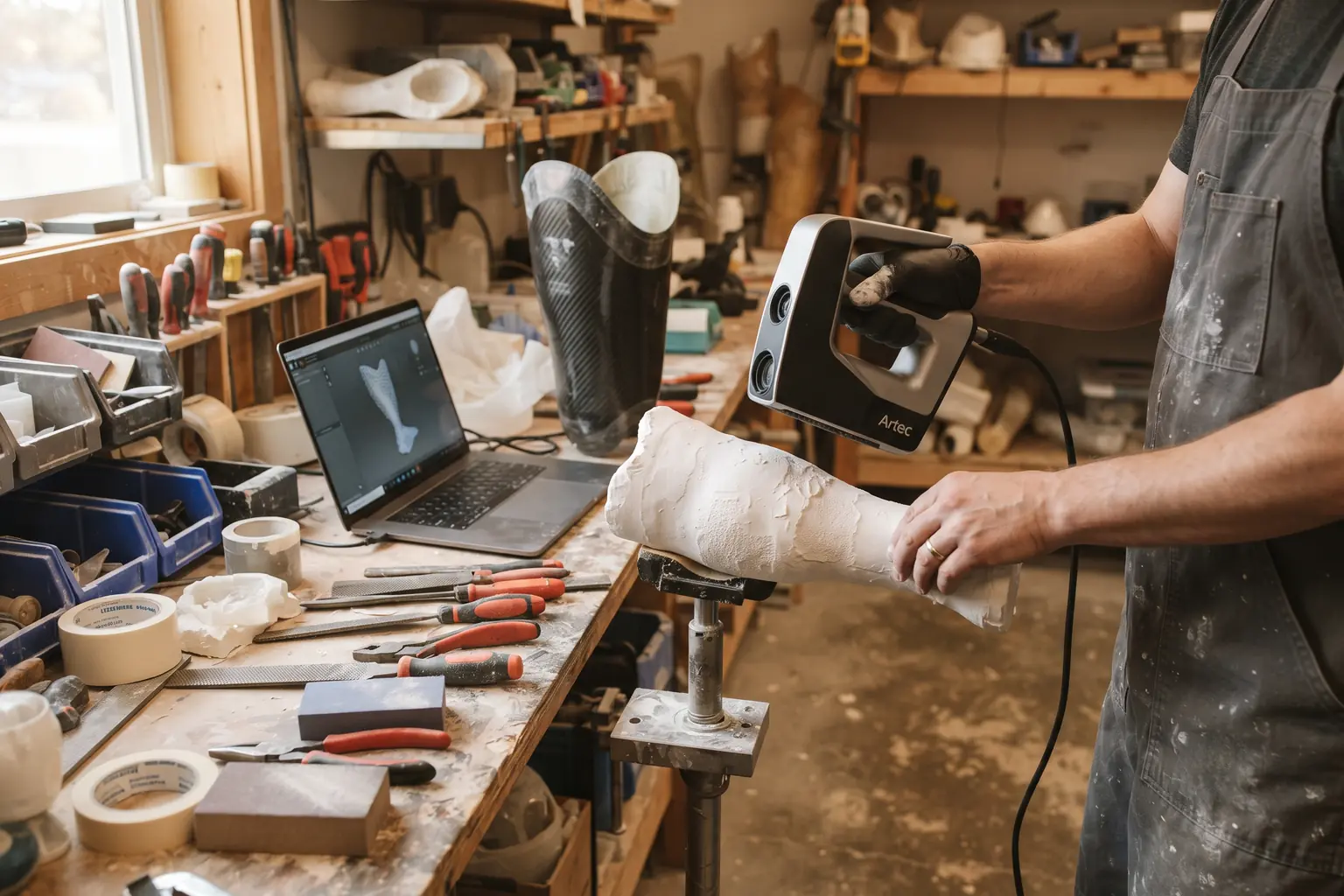
The O&P EDGE ran a first-person piece this week from a clinician who has been fitting prostheses for more than two decades, fifteen of them alongside the rise of 3D printing and digital manufacturing. The reflection is worth reading if you are a practitioner. For people on the other side of the fitting table, the story is both simpler and more complicated.
The simple version: the tools prosthetists use to shape and test sockets have changed significantly. Plaster casting, the hands-on process of wrapping a residual limb to create a model for fabricating a socket, still exists, but it increasingly shares space with digital scanning, computer-aided design (CAD), and additive manufacturing, the category that includes 3D printing.
What actually changed
The core job of a prosthetic socket is to fit the residual limb precisely: distributing load, allowing suspension, and being comfortable enough to wear for most of a day. Traditional fabrication does that through skilled manual work: cast, modify, check, recast. Digital methods add a different pathway: scan the limb, adjust the shape in software, print or mill a check socket, assess the fit, iterate.
What that shift creates, at its best, is a more documented and repeatable process. A digital file of a socket can be stored and reproduced, which is useful if the device is damaged, or if someone moves and a new provider needs to start somewhere other than zero. Iterating on socket shape becomes easier to visualize and compare. Turnaround time on check sockets can shrink when the clinic has the equipment and the volume to run it efficiently.
What it does not create is a fit that is automatically better. Digital tools require skill to operate and judgment to interpret. A bad scan, or a well-processed scan with the wrong modifications, still produces a socket that does not fit. The shift is in the medium, not in the underlying challenge of matching a device to a body that changes with time, temperature, activity level, and health.
What didn’t change, and probably won’t
Residual limbs are not static. They change in volume over days, across seasons, and in response to systemic health. Good fitting accounts for that. The clinician’s piece in The O&P EDGE traces how dramatically the tools have advanced over fifteen years; it does not claim that software has resolved the judgment problem, and it is right not to.
Access to digital fabrication is also uneven. Larger clinic networks and academic medical centers are more likely to have invested in scanning equipment and in-house printing capacity. Independent practices vary. Geography and funding matter. The equipment available in a well-resourced urban O&P practice is not present everywhere, and neither the scan nor the printer changes that underlying disparity.
Insurance and Medicare reimbursement for digitally fabricated prostheses is its own moving target. CMS has updated DMEPOS documentation requirements multiple times as digital fabrication has grown. The billing classifications for custom-fabricated versus prefabricated devices, and the documentation each requires, are questions for your provider’s billing staff and your insurer. The answers vary by plan, by state, and by what a provider can support administratively. Technology does not resolve those questions; it introduces new versions of them.
What this means
If you are currently being fitted, or due for a replacement, it is reasonable to ask your prosthetist what fabrication methods they use and why. Not because one method is universally superior, but because understanding the process helps you ask better follow-up questions: about timeline, iteration, what happens if the first socket does not fit right, and what your documentation looks like for future care.
If you are switching providers, ask whether your current clinic can provide digital files of previous sockets or scans. Not every clinic can or will, but establishing that early in a transition is worth the conversation.
The clinician who spent fifteen years watching this change from inside the lab would probably describe it accurately: digital manufacturing has altered O&P practice meaningfully, made certain things faster and more reproducible, and left the hard parts (fit, access, coverage, the variability of human bodies) largely intact. That is not a criticism of the technology. It is a reasonable description of what technology can and cannot do when the problem is this specific.
This article draws on industry reporting and does not constitute fitting, clinical, or insurance advice. Questions about your prosthetic care should be directed to your certified prosthetist and care team.
Source notebook: This reporting draws on The O&P EDGE's clinician reflection on 15 years of digital manufacturing ↗. We link out so you can follow the receipts.