
Fifty years of transradial socket suspension: what a long-time user thinks of the newer designs
An O&P EDGE contributor who has worn upper-limb prostheses for more than five decades reviews the evolution of adjustable, self-suspending transradial socket designs, and what that long-term view contributes to a fitting conversation.
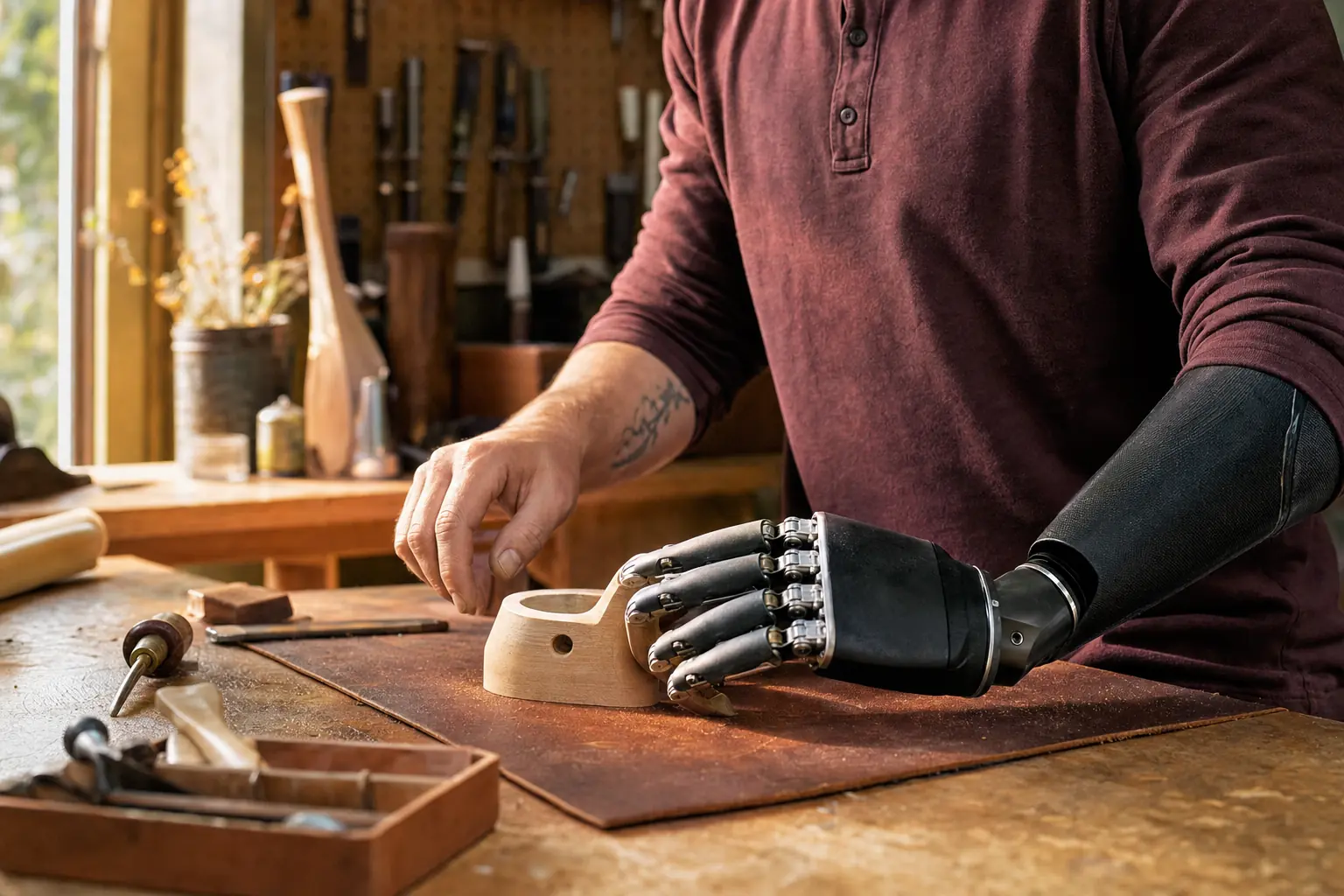
The suspension question is usually the last one people think to ask and the one that shapes every other decision about a transradial prosthesis.
Self-suspending socket designs, the kind that use the anatomy around the elbow to stay put, without an external harness, have existed for decades. The O&P EDGE published an account this week from a contributor who has worn upper-limb prostheses for more than 50 years and has used adjustable, self-suspending transradial designs specifically for nearly a decade. That combination of tenure and daily experience is not common in clinical literature, and it’s worth taking seriously.
What “self-suspending” actually means at the elbow
For a transradial (below-elbow) user, the residual limb includes a working elbow. The bones of the upper arm end in two bony prominences, condyles, that are wider than the arm shaft above them. Self-suspending socket designs lock their proximal trimline above those condyles, using the anatomy to prevent the socket from sliding off. The result: suspension from the residual limb itself, with no harness, chest strap, or separate sleeve.
The design families have different names: supracondylar, supracondylar-supraepicondylar, Muenster, each taking a slightly different angle on trimline height and how tightly the socket engages the elbow. What they share is that none of them require the figure-8 harness that older transradial systems often used.
For a lot of wearers, eliminating the harness is not a minor convenience. It removes a pressure source across the opposite shoulder and shoulder blade, simplifies getting dressed, and reduces movement restriction during reach. It also means the socket is doing more work, and it demands more precision because of it. A self-suspending fit that’s off by a meaningful margin tends to announce itself quickly.
The adjustment factor
The evolution the O&P EDGE article traces is specifically about adjustable self-suspending designs: sockets that incorporate components allowing walls to be modified after fabrication. The practical motivation is something anyone who has worn a prosthesis through a full day understands: residual limbs change volume. Temperature, activity level, time of day, a long flight, a hot commute: all of it affects how the socket fits by afternoon.
Adjustable designs try to address that without requiring multiple sockets or a trip back to the clinic every time body composition shifts. A user who has worn them for nearly a decade has something most research doesn’t: an account of what this looks like across time, in real conditions, including the parts that work and the parts that don’t.
What changes and what doesn’t
Self-suspending designs don’t change what the terminal device does. A hook is a hook; a hand is a hand. What changes is the interface: how the socket behaves during elbow flexion, how much it moves when the arm swings, what the donning and doffing process looks like every morning, whether fit anxiety accumulates over the course of a day or not.
These factors matter for whether a device gets used. Abandonment rates in the upper-limb category are meaningfully higher than in lower-limb prosthetics, and mismatch between interface reality and daily life is part of what drives that. A socket that demands constant monitoring or that restricts elbow motion in ways the fitting appointment didn’t reveal tends to end up in a closet.
What to bring to the next fitting conversation
If you use a transradial prosthesis and haven’t discussed self-suspending designs recently, or if you tried one and found the fit restrictive, the adjustable variants are worth specifically asking about. They are not new, but they are not universally offered either.
Questions that tend to produce useful answers:
- Is my residual limb length and elbow anatomy suited to a self-suspending design?
- What trimline approach do you prefer, and why does it fit my situation better than alternatives?
- What happens to suspension when my limb swells, and does this design have a built-in response to that?
- What does donning and doffing feel like, and what’s the realistic learning curve?
- At what point should I call about fit versus try to accommodate volume changes on my own?
The O&P EDGE piece is useful not because it announces a new product but because it offers what that kind of tenure actually produces: a frank account of what a specific design approach has looked like across decades of use. Clinicians see many patients. Someone who has worn the same category of device for fifty years has a different, complementary kind of knowledge. Both belong in the room when a socket is being designed.
Amputee News does not provide individualized medical or device-fitting advice. Socket design depends on residual limb anatomy, elbow function, activity level, and clinical factors that require direct assessment. Discuss suspension options with your prosthetist.
Source notebook: This reporting draws on The O&P EDGE, first-person account of 50-plus years wearing transradial prostheses, including nearly a decade with adjustable self-suspending designs ↗. We link out so you can follow the receipts.