
An amputee footballer is running a half-marathon. Here is what distance training actually demands from a prosthesis.
Moving from team sport into endurance running with limb loss changes the equipment calculus, the skin-care workload, and the socket-fit timeline. A practical look at what that transition actually involves.
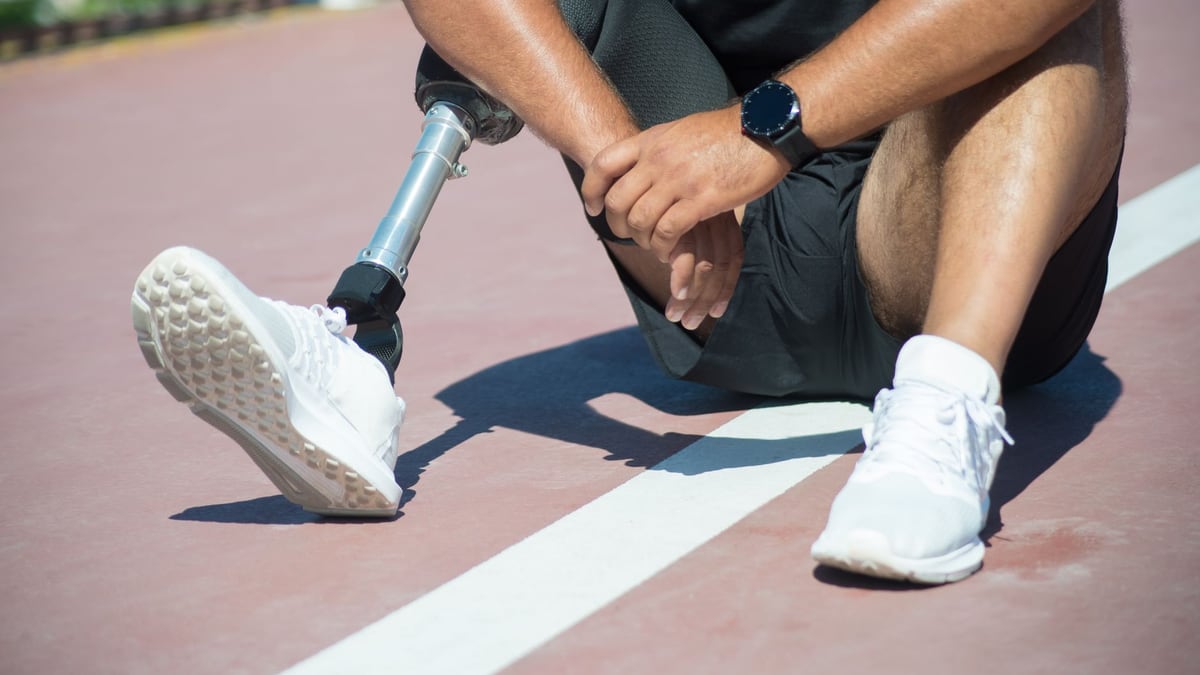
A footballer on the Isle of Man named Jackson is running his first half-marathon. Isle of Man Today covered it as a local interest piece. What that piece does not cover, because it is not that kind of story, is what it actually takes to get from team-sport athlete to distance runner when a prosthesis is part of the equation.
That is the less photogenic part. Also the part that is useful.
The component question
The first practical question when a lower-limb amputee starts building toward distance: can your current prosthesis handle it?
Standard prosthetic feet are designed for walking: the cadence, ground forces, and joint loading of daily ambulatory life. Some higher-category carbon-fiber dynamic-response feet have biomechanical properties that also support jogging and slower running. But as volume and pace increase, the mismatch between a daily-use component and a running-optimized one becomes relevant, in performance terms, and in what sustained running does to the socket, suspension, and surrounding tissue.
Running-specific prosthetic blades are genuinely different tools. They are carbon-fiber leaf-spring designs built to store and return energy across a running gait cycle, not a walking one. For significant distance volume, many prosthetists will recommend exploring a sport-specific option rather than asking a daily-use foot to serve both functions.
The coverage situation: Medicare does not cover running-specific prostheses, classifying them as recreational equipment outside the scope of functional-mobility coverage. The logic is not entirely irrational (a blade optimized for running is not a good ambulatory device for daily life), but the practical result is that a running prosthesis is an out-of-pocket cost or a grant application for most people outside the VA system. The Challenged Athletes Foundation grant program exists partly because of this gap, and it can cover running-specific components. The application takes time; if a sport-specific blade is in the plan, applying before training rather than after is the right move.
For someone whose existing prosthesis handles light running comfortably and who is training toward a half-marathon at moderate pace, a blade may not be required. Whether it is a conversation worth having depends on the person, the setup, and the goal, which is exactly why having that conversation with a prosthetist at the beginning of a training block is more useful than having it at week ten when something has started to hurt.
What a training block actually does to a residual limb
Distance running involves repetitive loading, sustained heat, and a significant amount of time inside a socket. Each of those things is worth understanding before a training block starts.
Socket fit drift. Body composition changes during sustained training. Muscle develops, subcutaneous tissue shifts, and residual limb volume changes, sometimes faster than a standard fit-check schedule anticipates. A socket that fits well at week one may fit differently at week eight. The signs of drift (pressure points, hot spots, pistoning, increased end-of-day soreness) are worth addressing early. Most prosthetists who work with active patients recommend scheduling a fit check midway through a significant training block, not just at the point when something starts going wrong.
Skin integrity. Sustained running generates friction, heat, and moisture inside the socket at levels that are categorically different from daily ambulation. For lower-limb amputees, the residual limb’s skin becomes a training load management problem in its own right. Contact dermatitis, folliculitis, skin breakdown, and blisters are all more likely when running volume increases faster than skin and tissue have adapted.
Liner hygiene matters more during training than during normal use: cleaning liners after every session, rotating between two liners to allow complete drying, checking for liner degradation regularly. An end-of-session skin check, looking at the residual limb the way a runner checks their feet, is not overcautious. What the socket environment looks like at mile eight of a training run is different from what it looks like after a trip to the grocery store.
Volume progression. The standard guidance for building running volume (roughly 10% per week as a ceiling) applies here and arguably applies with more patience. The constraint is not cardiovascular capacity. It is the time the residual limb, socket interface, and surrounding tissue need to adapt to sustained loading. That adaptation is real and measurable, and it takes longer than enthusiasm tends to budget for. Starting from zero running volume and arriving at half-marathon readiness in six weeks is a different category of problem when a socket is involved.
The community that actually exists
Achilles International is the most relevant organization for someone in this situation. It is a nonprofit that partners with road-race events and maintains a chapter network specifically for runners with physical disabilities, including amputees. The orientation is genuinely toward community-level participation (recreational and first-time distance runners, not exclusively competitive athletes), and chapters typically include pace groups, volunteer guides for runners who want support, and event-day coordination. If you are in a major metropolitan area, there is probably an Achilles chapter. If you are not, the organization is worth contacting anyway; chapters vary in size and activity level, and remote connection to athletes in similar situations is real.
Move United chapter locators can surface local adaptive running programs. The information that moves through those communities (which local events have adaptive categories, which prosthetists in the area have actual running experience, what works when a socket acts up at mile seven) is not in any guide. It moves in conversation.
For event registration: most major road races have adaptive or wheelchair categories and will communicate expected start position, wave placement, and finish-line timing procedures. Worth confirming before race day, not during registration.
What this means practically
Before you start building volume: Talk to your prosthetist. Not for permission, but for information about whether your current setup can handle the load you are planning and what adjustments might be warranted as training progresses. That conversation at week one is more useful than the same conversation at week ten when something is already wrong.
During training: Treat residual limb checks as part of the training routine. Daily liner hygiene, post-run skin inspection, scheduled prosthetist visits at meaningful intervals. The advice about listening to your body applies; the surface area of what to listen to is just larger.
For equipment funding: Challenged Athletes Foundation at challengedathletes.org handles grant applications for adaptive sport equipment. If a running-specific prosthesis is the conversation, apply early in the process rather than after the training block is underway.
For community: Achilles International chapter locator, Move United affiliates, and the Amputee Coalition’s peer network are all reasonable starting points. People who have trained through a half-marathon with a prosthesis have encountered and solved problems that are not documented anywhere. That knowledge is worth the conversation.
An amputee athlete on the Isle of Man is doing this thing. The headline writes it as a feel-good local piece. The more interesting version is that it is a person training for a race, with the equipment decisions and the skin-check routines and the prosthetist appointments that implies. That part is usually not in the story.
Amputee News does not provide individualized medical, clinical, or fitting advice. Before beginning or significantly increasing a running program, people with lower-limb limb loss should work with their care team and prosthetist. Program availability and grant cycles change; verify current information directly with the organizations listed.
Source notebook: This reporting draws on Isle of Man Today: Jackson's first half-marathon ↗. We link out so you can follow the receipts.